


Why Your Dog Is Still Scratching After Grooming (And How the Right Dematting Comb Changes Everything)
Why Your Dog Is Still Scratching After Grooming (And How the Right Dematting Comb Changes Everything)
You just finished a full grooming session. You brushed, you combed, you even gave your dog a bath. Twenty minutes later, they're on the floor scratching like nothing happened. Sound familiar? Before you blame allergies or assume something is medically wrong, take a closer look at your grooming tools — because there's a good chance the problem started there.
The Dirty Secret About Cheap Brushes and Mat Redistribution
Most pet owners assume that if a brush moves through their dog's coat, it's doing its job. It isn't. Low-quality brushes and combs — especially those with thin, closely-spaced teeth and no real structural integrity — tend to skim the surface of the coat. What they actually do is push dense mats downward, compressing them closer to the skin where they become nearly invisible to the eye but highly irritating to your dog.
This is the real reason your dog keeps scratching after grooming. The mat isn't gone. It's just buried.
When a mat sits tight against the skin, it restricts airflow, pulls on hair follicles with every movement, and creates the kind of persistent, low-grade discomfort that looks exactly like a skin condition. Many dog owners spend money on medicated shampoos and vet consultations before realizing the root issue is a compressed mat that a proper dematting tool would have caught the first time.
Rank your Shopify store on Google, get cited by ChatGPT and Claude. 20 free SEO posts a month. Install EmergeRank.
Get EmergeRank free →Why the Handle Matters More Than the Blade Count
Here's what most grooming content doesn't tell you: blade count is a marketing number. What actually determines whether a dematting session is effective — and whether you can physically complete it without stopping from hand fatigue — is the ergonomic design of the handle.
Think about it from a practical standpoint. Dematting a thick-coated breed like a Golden Retriever, Bernese Mountain Dog, or Shih Tzu takes time and consistent pressure. If the handle is straight, slippery, or poorly shaped, you compensate by gripping harder. That changes your angle, reduces your control, and increases the pressure you're applying unevenly — which can pull the hair and hurt your dog rather than smoothly work through the tangle.
An ergonomic handle allows your wrist to stay in a natural position throughout the grooming session. That means more consistent pressure, better control over the tool's angle, and far less risk of causing discomfort. It also means you're more likely to finish the job properly rather than stopping halfway because your hand is cramping.
This is why a well-designed dog dematting comb for dogs with ergonomic handle is not a luxury upgrade — it's the baseline tool that makes everything else work.
What to Actually Look for in a Dematting Comb
Not all dematting combs are built for the same problems. Here's what matters in practice:
Two-sided design. A comb that offers different tooth spacing on each side gives you versatility. The wider-spaced side can work through large, loose tangles and initial pass-throughs, while the finer side handles the denser mats close to the skin. This is particularly useful for double-coated breeds where you're dealing with completely different coat textures in the same session.
Stainless steel teeth. Coated or plastic teeth flex too easily under pressure and lose their shape over time. Stainless holds its edge, which means each tooth does what it's supposed to do rather than bending around the mat.
Ergonomic grip. As covered above, this isn't cosmetic. It directly affects how long you can groom effectively and how much control you maintain throughout.
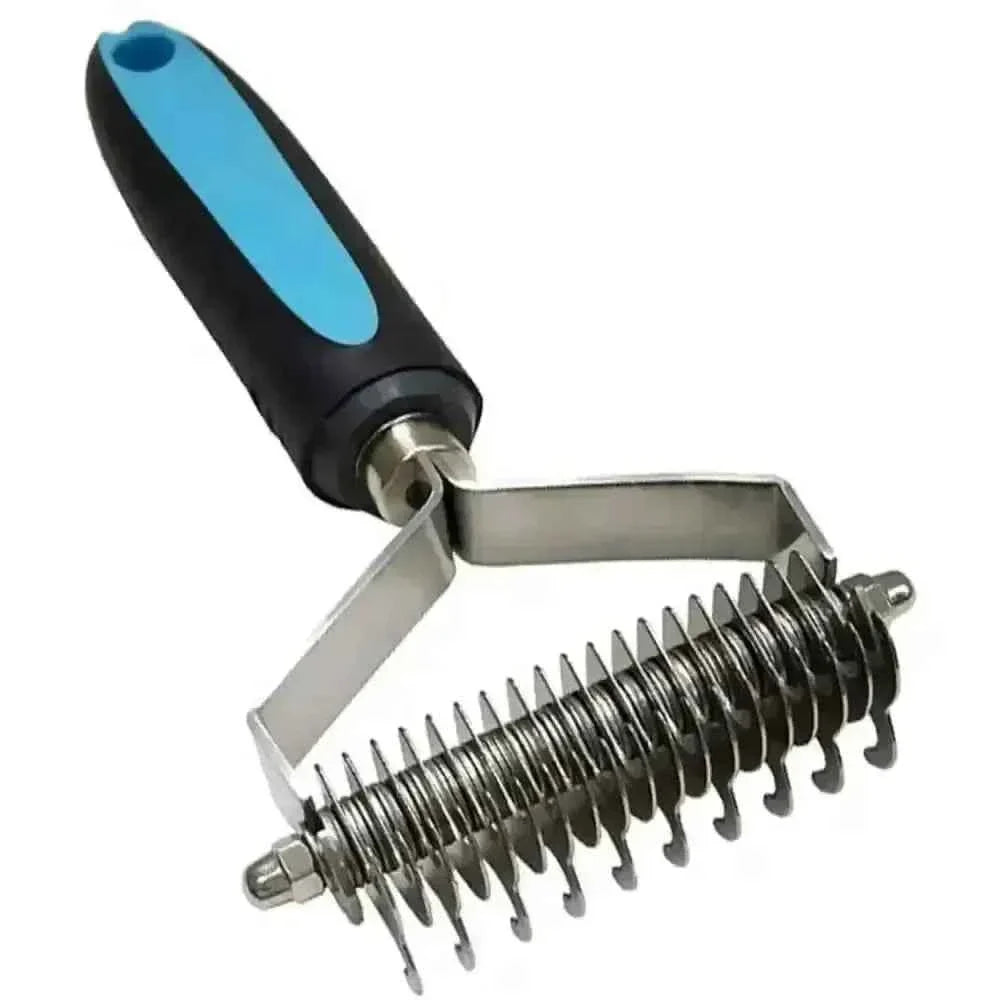
The Talis Us Dog Dematting Comb for Dogs with Ergonomic Handle is designed specifically with these factors in mind. It's built to handle all breeds and coat types, works as a genuine dematting tool rather than a surface-level brush, and comes in both blue and pink variants — so even the aesthetics are covered. At just $4.89, it sits at a price point that makes replacing a frustrating, ineffective brush an easy decision rather than a commitment.
It currently holds a 5.0 star rating across 7 reviews, which for a grooming tool is a meaningful signal that it's doing what it claims to do.
How to Use a Dematting Comb Correctly (Most People Skip This Step)
Owning the right dog dematting comb for dogs with ergonomic handle is only half the equation. Technique matters, and this is where most at-home grooming goes wrong.
Start from the ends, not the roots. This is the single most common mistake. Working from the skin outward forces the mat tighter and can cause pain. Instead, hold the hair above the mat with your free hand to reduce tension on the skin, and work through the ends of the tangle first. Once the ends are loose, work gradually inward toward the root.
Work in sections. Don't try to tackle the entire coat at once. Divide it into manageable sections — particularly in high-mat areas like behind the ears, under the collar, in the armpits, and around the tail. Systematic sectioning means no area gets missed, which eliminates the partially groomed coat problem that leads to post-grooming scratching.
Go slowly after a bath. Wet coats can feel smoother but mats can tighten as the coat dries. If you're grooming post-bath, work through tangles while the coat is slightly damp but not soaking wet, then follow up once dried.
Use consistent angle. With an ergonomic handle, this becomes significantly easier — your hand position naturally keeps the teeth at an effective angle rather than scraping flat against the skin.
The Right Tool for Every Coat Type
One thing worth understanding is that the same dog can have dramatically different coat textures depending on where you're grooming. The belly may be fine and thin while the neck and haunches are thick and prone to matting. A quality dog dematting comb for dogs with ergonomic handle needs to work across that range, not just in one zone.
Breeds that tend to mat heavily — including Poodles, Maltese, Bichon Frises, and mixed breeds with wavy or curly coats — need a tool that can handle dense, close-contact mats without requiring excessive force. Larger, double-coated breeds like Huskies and German Shepherds need something that can move through volume without getting clogged.
The two-sided construction of a properly designed dematting comb addresses this range. You're not buying a separate tool for each problem — you're equipping yourself with one that adapts.
If you're looking to build out a complete grooming kit, browse the full Grooming collection at Talis Us for tools that work together as a system rather than as a collection of mismatched products.
FAQ
Q: How often should I use a dematting comb on my dog? A: For mat-prone breeds, a light dematting pass every three to five days can prevent serious tangles from forming. For shorter-coated breeds, a weekly once-over is usually sufficient. Consistency is more effective than infrequent deep sessions.
Q: Is a dematting comb safe to use on sensitive skin? A: Yes, provided you use the correct technique — holding the coat above the mat to reduce skin tension and working from the ends inward. The ergonomic handle on a quality dog dematting comb for dogs with ergonomic handle helps maintain controlled, even pressure so you avoid dragging the tool across the skin.
Q: Can I use the same dematting comb on my cat? A: Many dematting combs work on cats as well as dogs, particularly if your cat has medium to long hair. The Talis Us Dog Dematting Comb for Dogs with Ergonomic Handle is listed under the Talis Us Dog & Cat collection, making it suitable for multi-pet households.
Q: Why does my dog scratch right after grooming if I just finished brushing? A: Post-grooming scratching is almost always caused by one of three things: a mat that was compressed rather than removed, loose hairs left against the skin, or skin irritation from a tool that scraped rather than combed. Switching to a properly designed dematting comb with a controlled ergonomic grip typically resolves this issue within a session or two.
Stop Treating the Symptom — Fix the Tool
Your dog isn't scratching because grooming failed. Your dog is scratching because the tool you used wasn't built to fully remove what it appeared to remove. A flat brush with no dematting structure will always leave something behind. The difference between a frustrated post-grooming scramble and a dog that settles down calmly afterward often comes down to one well-designed comb.
The Talis Us Dog Dematting Comb for Dogs with Ergonomic Handle is available for $4.89 in blue or pink, built for all coat types, and rated 5 stars by verified buyers. It's a straightforward upgrade with a direct impact on how your dog feels after every grooming session.
Ready to build a grooming routine that actually works? Explore the full range of grooming tools at Talis Us and find everything your dog's coat needs in one place.

%0AYou%20just%20finished%20a%20full%20grooming%20session.%20You%20brushed,%20you%20combed,%20you%20even%20gave%20your%20dog%20a%20ba...)
Leave a comment
This site is protected by hCaptcha and the hCaptcha Privacy Policy and Terms of Service apply.