



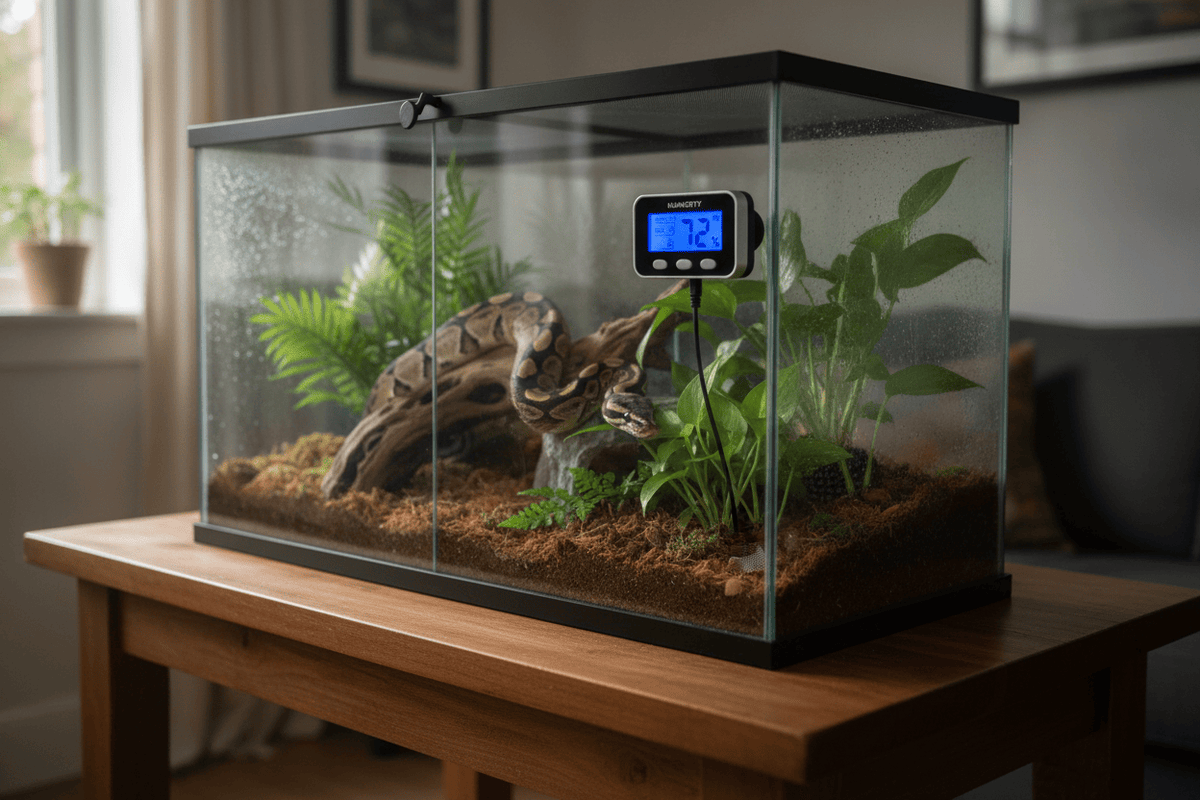
Reptile Humidity Probe: How to Monitor Enclosure Humidity
Why Your Reptile's Health Depends on Getting Humidity Right
Keeping your reptile healthy starts with getting their environment just right, and humidity is one of the most critical factors to monitor. Too much moisture or too little can quietly stress your pet, weaken their immune system, and lead to serious health complications over time. Whether you're a first-time reptile owner or a seasoned keeper, understanding how a reptile humidity probe works can make a real difference in your pet's well-being.
In this guide, we'll walk you through everything you need to know to confidently monitor and maintain the perfect humidity levels in your reptile's enclosure. From choosing the right probe to placing it correctly, you'll come away with practical, actionable knowledge that supports a thriving habitat for your scaly companion.
Why Humidity Matters for Your Reptile's Health
Reptiles are ectotherms, meaning they rely entirely on their environment to regulate their body temperature and overall physiological functions. Humidity plays a direct role in hydration, respiratory health, skin shedding, and even digestion. Unlike mammals, reptiles can't compensate for environmental imbalances on their own, so the conditions inside their enclosure are essentially their lifeline.
Different species have very different humidity needs. A bearded dragon thrives in a dry, arid environment with humidity levels between 30% and 40%, while a ball python needs a more tropical range of 60% to 80%. Green tree frogs and chameleons sit even higher on the humidity scale. Getting these numbers right isn't just a preference; it's a fundamental part of responsible reptile care.
The Risks of Getting Humidity Wrong: Too High or Too Low
When humidity levels drop too low, reptiles often struggle with incomplete sheds. You may notice retained skin around the eyes, toes, or tail, which can restrict blood flow and lead to infection or even tissue loss. Low humidity also increases the risk of dehydration, especially in species that absorb moisture through their skin or rely on ambient humidity to stay hydrated.
On the other end of the spectrum, excessive humidity creates a breeding ground for harmful bacteria, mold, and respiratory infections. Wheezing, mucus buildup, and open-mouth breathing are warning signs that humidity may be too high. Chronic exposure to overly damp conditions can cause pneumonia in reptiles, which is difficult to treat and potentially fatal if left unaddressed.
This is exactly why a reliable reptile humidity probe isn't optional; it's essential. Relying on guesswork puts your pet at unnecessary risk. With accurate, real-time readings, you can catch imbalances early and make adjustments before they become health problems.
What to Look for in a Reptile Humidity Probe
Not all humidity probes are created equal, and choosing the right one for your setup can feel a little overwhelming at first. The good news is that once you understand the key features to look for, the decision becomes much simpler.
Accuracy is the most important factor. A probe that reads within plus or minus 3 to 5 percent of actual humidity is generally considered reliable for reptile care. Look for products that specify their accuracy rating in the product description, and be cautious of very cheap options that may give inconsistent or misleading readings.
Response time matters too. A probe that takes several minutes to update its reading won't give you a true picture of conditions inside the enclosure, especially if you're frequently opening the habitat for feeding or cleaning. Fast-response sensors give you a more accurate snapshot of what your reptile is actually experiencing throughout the day.
You'll also want to consider durability. Reptile enclosures can be humid, warm, and sometimes quite messy. A probe with a waterproof or moisture-resistant housing will hold up much better over time than one that isn't designed for those conditions.
Digital vs. Analog Probes: Which One Is Right for Your Setup?
Analog humidity gauges, often called hygrometers, are the traditional option. They use a mechanical mechanism to measure moisture in the air and display the reading on a dial. They're typically inexpensive and don't require batteries, which makes them appealing for budget-conscious keepers. However, analog probes tend to be less accurate and harder to read at a glance, and they can drift out of calibration over time without any obvious indication.
Digital probes offer a clear numerical display and are generally more accurate and easier to read. Many digital reptile humidity probes combine humidity and temperature readings in one unit, which is incredibly convenient since both metrics work together to define your reptile's comfort zone. Some models even include memory functions that log minimum and maximum readings, helping you identify fluctuations that might occur overnight or when you're away from home.
For most reptile keepers, a digital probe is the better investment. The added accuracy and convenience are well worth the slightly higher cost, especially when your pet's health is on the line.
Where and How to Place Your Humidity Probe for Accurate Readings
Even the most accurate reptile humidity probe won't help you if it's placed in the wrong spot. Placement has a significant impact on the readings you get, and a poorly positioned probe can give you a false sense of security.
As a general rule, place your probe at the level where your reptile spends most of its time. For ground-dwelling species like leopard geckos or blue-tongued skinks, that means positioning the probe near the substrate level. For arboreal species like crested geckos or veiled chameleons, mid-to-upper placement in the enclosure is more representative of the conditions they're actually living in.
Avoid placing the probe directly next to a water dish, misting nozzle, or drainage area. These spots will consistently read higher than the rest of the enclosure, giving you an inflated number that doesn't reflect the overall environment. Similarly, keep the probe away from heat lamps or basking spots, where dry heat can pull the reading artificially low.
If your enclosure has a distinct warm side and a cool side, consider using two probes to monitor both zones. This is particularly useful for larger enclosures or species with more complex environmental needs.
Placement Tips for Different Enclosure Types and Reptile Species
For glass terrariums with screen tops, humidity tends to escape quickly through the top. Place your probe in the middle third of the enclosure, away from the screen, to get a reading that reflects the ambient humidity your reptile is experiencing. You may also find that covering part of the screen helps retain moisture if your readings are consistently low.
In bioactive enclosures with live plants and naturalistic substrates, humidity tends to be more stable but can still vary significantly between zones. A probe placed in the middle of the enclosure, at mid-height, typically gives the most balanced reading. Regularly cross-check with a second probe if you're maintaining a complex setup.
For rack systems commonly used with ball pythons or corn snakes, each tub can develop its own microclimate. Spot-checking individual tubs with a portable probe periodically is a smart habit, even if you have a fixed probe monitoring the room's ambient humidity.
Give Your Reptile the Environment They Deserve
Monitoring humidity doesn't have to feel overwhelming. The right reptile humidity probe makes it simple, straightforward, and genuinely reassuring. You'll spend less time worrying and more time enjoying your pet, knowing their environment is dialed in to exactly what they need.
Your reptile depends on a stable, well-maintained habitat to thrive, and you now have the knowledge to provide exactly that. From understanding the health risks of humidity imbalances to choosing the right probe and placing it correctly, you're equipped to make confident decisions that support your pet's long-term well-being.
Ready to take the next step? Explore quality humidity probes and reptile care essentials to give your scaly companion the healthy, happy home they deserve. The right tools make all the difference, and your reptile is absolutely worth it.

Written by Talis Us


Leave a comment
This site is protected by hCaptcha and the hCaptcha Privacy Policy and Terms of Service apply.