


What's the Safest Corn Snake Setup for Beginners?
What's the Safest Corn Snake Setup for Beginners?
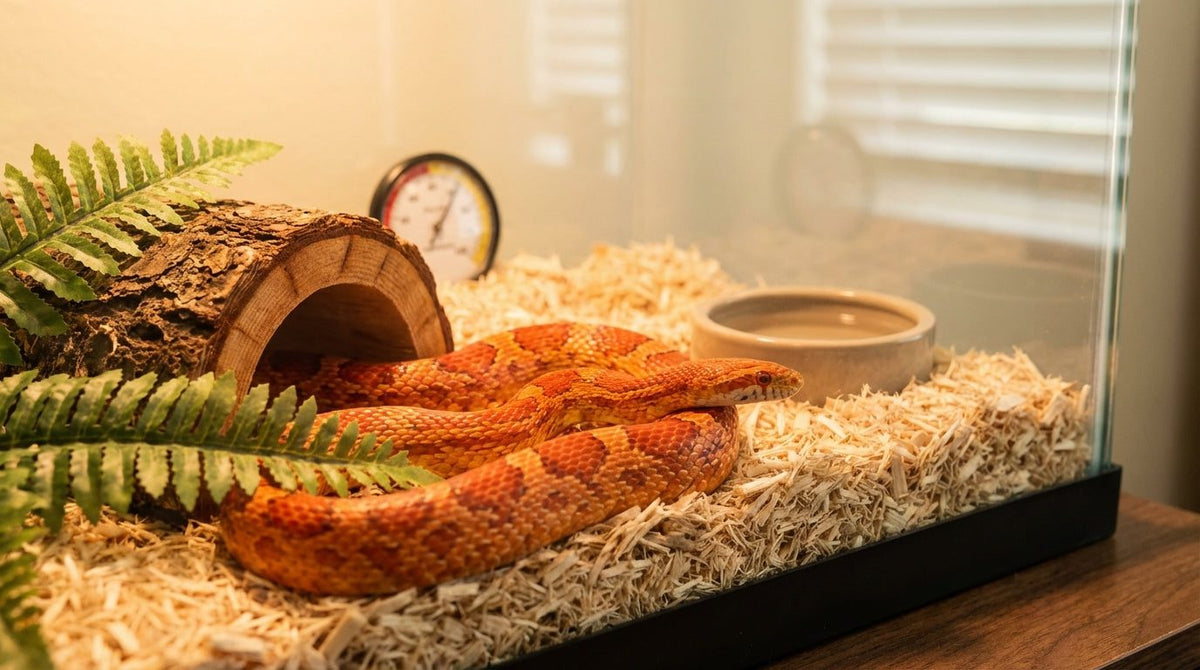
Corn snakes (Pantherophis guttatus) consistently top the list of best beginner reptiles — and for good reason. They're docile, hardy, manageable in size, and far more forgiving of minor husbandry errors than most other reptile species. With proper care, they live 15–20+ years, making them a genuinely rewarding long-term companion.
But "beginner-friendly" doesn't mean setup is optional. The most common corn snake health problems — burns, respiratory infections, stuck shed, escape injuries — all trace back to preventable setup mistakes. Get the habitat right before your snake arrives, and you eliminate most risks from day one.
This guide covers every element of the safest corn snake setup for beginners, backed by veterinary guidance and experienced keeper recommendations.
TLDR
-
Enclosure: 20-gal for juveniles → 40-gal+ for adults; escape-proof lid with clips is non-negotiable
-
Temperature: 80–85°F warm side, 70–75°F cool side; always use a thermostat with any heat source
-
Humidity: 40–60% normally; bump to ~70% during shedding
-
Substrate: Aspen shavings or cypress mulch — never cedar or pine
-
Hides: Minimum two — one warm side, one cool side
-
Feeding: Frozen-thawed mice only; size to snake's mid-body width; feed with tongs
-
Lighting: 8–12 hours UVA/UVB daily; no white lights at night
Table of Contents
Why Corn Snakes Are Ideal for Beginners
According to PetMD's veterinary care sheet, corn snakes are rated "Beginner" difficulty — the only care level lower than all other popular pet snake species. Key reasons:
-
Docile temperament: Rarely bite; tolerate handling exceptionally well even as juveniles
-
Manageable size: Adults reach 4–6 feet — substantial but not overwhelming
-
Forgiving husbandry: They tolerate a fairly wide humidity and temperature range
-
Simple diet: Frozen-thawed mice; no live feeding required
-
No venom: Completely non-venomous constrictors
-
Long lifespan with proper care: 15–20+ years (Bean Farm)
As Packerland Veterinary Center notes, corn snakes have environmental requirements that are "a little less stringent than many other snakes and reptiles" — but that doesn't mean they can be neglected. The setup you create before bringing your snake home determines the quality of every year that follows.
Enclosure: Size, Type & Escape Prevention
Size by Age
| Age | Minimum Enclosure Size |
|---|---|
| Hatchling / Baby | 10-gallon tank |
| Juvenile (6–18 months) | 20-gallon long |
| Adult (2+ years) | 40-gallon breeder or larger |
A 40-gallon breeder tank (36" × 18" × 16") is the standard adult minimum. Larger is always better — the myth that large enclosures stress snakes is exactly that, a myth. Corn snakes thrive in larger spaces when furnished with adequate hides and cover. (Bean Farm)
Many experienced keepers recommend starting with a 40-gallon from day one to avoid multiple costly upgrades as the snake grows.
Enclosure Type
-
Glass aquariums with screen lids are the most widely available and work well for corn snakes
-
Front-opening PVC enclosures hold heat and humidity better than glass and are less startling to snakes (approaching from above triggers predator avoidance instincts)
-
Avoid fully sealed terrariums without mesh — ventilation is critical
At Talis-us, the Zilla QuickBuild Terrarium with Easy Clean Bedding Tray is a well-designed beginner option with a removable bedding tray that makes cleaning far easier — available from $159.99.
⚠️ Escape Prevention — Non-Negotiable
Corn snakes are skilled escape artists. They will probe every gap, push against lids, and squeeze through openings that seem impossibly small. (Alpha Veterinary Center)
-
Always use a screen lid with locking clips — not just a resting lid
-
Check all seams, corners, and lid edges for gaps before placing the snake
-
Never assume a lid is "tight enough" — verify with physical locks
-
A lost corn snake is a safety risk for the snake (dehydration, injury, temperature exposure) and a household stress
Temperature: The Thermal Gradient
Corn snakes are ectotherms — they regulate body temperature by moving between warm and cool zones. A proper thermal gradient is one of the most critical elements of a safe setup.
| Zone | Target Temperature |
|---|---|
| Warm side (basking area) | 80–85°F (up to 88°F at basking spot) |
| Cool side | 70–75°F |
| Nighttime (whole enclosure) | 68–75°F |
Two thermometers — one on each side — are essential for monitoring both zones simultaneously. Digital probe thermometers are far more accurate than stick-on dial thermometers, which are notoriously unreliable. (PetMD)
An infrared temperature gun (non-contact thermometer) is also a worthwhile investment for instant spot-checks of surface temperatures on the substrate and hides.
Heating Equipment & Thermostat Safety
This is where most beginner safety failures occur. Unregulated heat sources are the leading cause of thermal burns in captive corn snakes. (MorphMarket Community)
Safe Heating Options
| Method | Notes |
|---|---|
| Under-tank heat mat (UTH) | Place under one-third of tank; MUST be connected to a thermostat |
| Ceramic heat emitter (CHE) | Produces heat without light — good for nighttime use |
| Low-wattage basking bulb | Daytime use only; switch off at night to preserve sleep cycle |
| Radiant heat panel | Mounts to ceiling of enclosure; good for front-opening PVC enclosures |
What to Avoid
-
❌ Heat rocks — Malfunction frequently and cause severe, slow-onset burns; banned by most experienced keepers
-
❌ Unregulated heat mats — Can overheat dramatically; a thermostat is mandatory, not optional
-
❌ Hot spots above 90°F — Snakes resting on overheated substrate suffer burns that may not be visible for days
The Thermostat Rule
Always connect every heat source to a thermostat. No exceptions.
A thermostat regulates the heat source automatically, cycling it on and off to maintain a consistent target temperature. Without one, heat mats can reach temperatures well above safe limits. This is essential safety equipment — not an optional upgrade. (Bean Farm, Packerland Veterinary Center)
Humidity & Ventilation
Corn snakes originate from the southeastern United States and need moderate humidity — not the high tropical levels of ball pythons.
| Condition | Target Humidity |
|---|---|
| Normal / daily | 40–60% |
| During shedding cycle | ~70% |
Monitor humidity with a digital hygrometer — dial hygrometers are inaccurate and should be avoided. Most homes naturally maintain 40–50% humidity, making corn snakes particularly low-maintenance in this regard. (Bean Farm)
To increase humidity during shedding:
-
Add a humid hide — a hide box filled with damp sphagnum moss on the warm side
-
Lightly mist one end of the enclosure
-
Ensure the water bowl is large enough for the snake to soak in
Ventilation matters: Screen-top lids on glass tanks provide good air exchange. Don't cover large portions of the screen to trap humidity — corn snakes don't need it, and stagnant air increases respiratory infection risk.
Substrate: Safe vs. Toxic Choices
Substrate selection directly affects both safety and comfort. Some common pet store beddings are outright toxic to snakes.
✅ Safe Substrates
| Substrate | Notes |
|---|---|
| Aspen shavings | Most popular; absorbent, allows burrowing, widely available; replace weekly if wet |
| Cypress mulch | Holds slight moisture (helpful during shedding); safe if accidentally ingested |
| Coconut husk / coco fiber | Good moisture retention; naturalistic appearance |
| Paper-based bedding | Excellent for quarantine or health monitoring; easy to replace |
| Newspaper / paper towels | Simple, functional, cheap — used by many breeders |
❌ Unsafe Substrates — Never Use These
-
Cedar shavings — Contains phenolic oils that cause respiratory irritation, skin lesions, and can be fatal to reptiles (PetMD)
-
Pine shavings — Same toxic oil compounds as cedar; equally dangerous
-
Sand — Causes impaction if ingested; inappropriate for corn snakes
-
Gravel or small stones — Impaction risk; no thermoregulation benefit
Important: When feeding on loose substrate (aspen, mulch), always move the snake to a separate feeding container or bare enclosure. Snakes can accidentally ingest substrate particles while striking prey, causing life-threatening gastrointestinal obstruction. (PetMD)
Hides, Climbing & Enrichment
Hides — The Most Critical Decoration
Corn snakes are naturally secretive and spend significant time hidden. Without adequate hides, they experience chronic stress — which suppresses immune function and causes feeding refusal.
Minimum requirement: Two hides
-
One on the warm side — allows the snake to thermoregulate while feeling secure
-
One on the cool side — provides temperature choice without exposure
Hides should be just large enough for the snake to fit snugly inside — too large and they won't feel secure. Upgrade hide sizes as the snake grows.
Options include: half-log hides, cork bark caves, commercial plastic caves, upturned flower pots. All should have smooth edges with no sharp points.
Humidity Hide
Add a third hide filled with damp sphagnum moss on the warm side during shedding periods. This microenvironment helps snakes shed in a single complete piece and prevents retained shed.
Climbing & Enrichment
Corn snakes are semi-arboreal and benefit from vertical space. Add:
-
Climbing branches or driftwood — secured so they can't shift or fall
-
Grapewood or cork bark flats — for elevated resting platforms
-
Artificial plants — provide visual cover and reduce stress
-
Rotated enrichment items — paper towel tubes, egg cartons, new hides — corn snakes are curious and benefit from novelty
Lighting Requirements
Corn snakes do not require UVB to metabolize calcium the way lizards do — but research increasingly shows that UVB exposure offers meaningful health benefits.
According to PetMD, daily exposure to UVA/UVB light can improve immune system function and promote normal behavior in snakes. Provide:
-
8–12 hours of UV light daily to simulate a natural day/night cycle
-
No white light at night — disrupts the snake's natural sleep cycle and affects long-term health
-
For nighttime heat without light: use a ceramic heat emitter or infrared/nocturnal bulb
-
Replace UV bulbs every 6 months — UV output degrades well before the visible light fails
If a UVB fixture isn't in your budget initially, a simple lamp on a timer providing a regular light cycle via ambient room light is a workable starting point — as noted by Packerland Veterinary Center.
Feeding Safely
What to Feed
Corn snakes eat whole prey — exclusively frozen-thawed mice in captivity. Live feeding is unsafe: live rodents can bite and scratch snakes, causing serious injuries and potentially fatal infections. (PetMD)
Prey size: match the diameter of the prey to the snake's mid-body width. A correctly sized meal leaves a barely visible lump after swallowing. Too large risks regurgitation; too small fails to provide adequate nutrition.
| Age | Prey Size | Frequency |
|---|---|---|
| Hatchling / Baby | Pinky mice | Every 5–7 days |
| Juvenile | Fuzzy / hopper mice | Every 7–10 days |
| Adult | Adult mice (or small rats for large adults) | Every 10–14 days |
How to Thaw Frozen Prey Safely
-
Remove prey from the freezer and seal in a plastic bag
-
Submerge in cold water until fully thawed
-
Transfer to warm water (~100°F) for 10–15 minutes to warm above room temperature
-
Never use a microwave — uneven heating creates hot spots that burn the snake's mouth
-
Never re-freeze thawed prey; discard if uneaten
Safe Feeding Technique
-
Always use feeding tongs — never fingers. Corn snakes have strong feeding instincts and may strike at the scent of prey on hands
-
Feed in the enclosure or a separate bare container — both methods work; the separate container approach prevents substrate ingestion
-
Feed in the evening or late afternoon when corn snakes are most naturally active
-
Wait 48 hours after feeding before handling — premature handling causes stress and regurgitation
Water & Hydration
Provide a shallow, stable water bowl large enough for the snake to soak in fully. Corn snakes absorb water through their skin and often soak before and during shedding.
-
Replace water daily — snakes frequently defecate in their water bowls
-
Disinfect the bowl weekly with reptile-safe cleaner or diluted bleach solution, rinsed thoroughly
-
During shedding, if your snake isn't soaking on its own, provide a 10–15 minute soak in lukewarm water 2–3 times per week (PetMD)
Handling: Building Trust Safely
The First Week
Give a newly arrived corn snake at least 7 days to settle in before any handling. Allow 2–3 successful feeding sessions before regular interaction begins.
Safe Handling Technique
-
Approach from the side, not above — approaching from above triggers predator-avoidance instincts
-
Scoop from below with both hands supporting the body
-
Let the snake move through your hands — restricting movement causes panic
-
Start with 5–10 minute sessions every few days; gradually extend as the snake becomes comfortable
-
Wash hands before handling to remove food scents that may trigger a feeding strike
-
Wash hands after handling — all reptiles are potential Salmonella carriers (PetMD)
When Not to Handle
-
During the opaque (blue-eye) shedding phase — vision is impaired, stress is higher
-
For 48 hours after any feeding
-
If the snake displays defensive postures: S-curve strike stance, tail vibration, or musking
Cleaning & Maintenance
| Task | Frequency |
|---|---|
| Spot-clean feces and soiled substrate | As needed / daily check |
| Refresh water bowl | Daily |
| Check temperatures | Daily |
| Deep-clean water bowl | Weekly |
| Full enclosure disinfection | Every 2–3 months (or immediately after illness) |
For full cleaning: remove the snake to a secure container, strip all substrate and decor, scrub with reptile-safe disinfectant or a 3% bleach solution (10-minute contact time), rinse thoroughly, allow to dry completely, then replace with fresh substrate and clean furnishings. (PetMD)
7 Beginner Safety Mistakes to Avoid
-
No thermostat on heat mats — The single most common cause of thermal burns; always use a thermostat, full stop
-
Using cedar or pine substrate — Toxic oils cause respiratory damage and skin lesions; use aspen or cypress mulch only
-
Lid without locking clips — Corn snakes escape through loose lids; clip every single time
-
Heat rocks in the enclosure — These malfunction regularly and cause severe burns; remove permanently
-
Handling within 48 hours of feeding — Causes regurgitation and digestive disruption; always wait
-
Panicking over food refusal — Corn snakes regularly skip meals during shedding, breeding season, or seasonal changes; patience and correct husbandry solve most cases
-
Housing multiple corn snakes together — They are solitary animals; co-habitation causes chronic stress, competition, and disease transmission (Bean Farm)
Signs of a Healthy Corn Snake
According to PetMD, look for these positive indicators:
-
✅ Clear, bright eyes (except during opaque shedding phase)
-
✅ Smooth, intact scales with no ulcerations or retained shed
-
✅ Clean vent with no discharge
-
✅ Regular tongue-flicking (active scent gathering)
-
✅ Alert, responsive behavior when disturbed
-
✅ Complete, single-piece sheds ("pulling off a sock")
-
✅ Consistent appetite on normal schedule
When to See a Reptile Vet
Contact a reptile-savvy exotic veterinarian if your corn snake shows:
-
Wheezing, open-mouth breathing, or mucus around the nose/mouth (respiratory infection)
-
Blisters, ulcerations, or discolored belly scales (scale rot)
-
Retained eye caps after shedding — do not attempt removal yourself
-
Repeated regurgitation (more than once)
-
Food refusal beyond 2 months with visible weight loss
-
Lethargy, sudden inability to move a section of the body
-
Swelling around the jaw or body
Find a qualified reptile veterinarian before you need one — not in an emergency. Ask your local exotic vet practice if they have reptile experience, and bring photos of your enclosure setup to annual checkups so the vet can assess full husbandry. (PetMD)
Beginner Setup Checklist
Before your corn snake comes home, confirm every item on this list:
| Item | Specification |
|---|---|
| ☐ Enclosure | 20-gal minimum (juvenile); 40-gal+ for adults |
| ☐ Secure lid | Screen lid with locking clips — no exceptions |
| ☐ Under-tank heat mat or basking bulb | Covering 1/3 of enclosure floor |
| ☐ Thermostat | Connected to every heat source |
| ☐ Two digital thermometers | One warm side, one cool side |
| ☐ Digital hygrometer | For humidity monitoring |
| ☐ UVB/UVA lighting + timer | 8–12 hour light cycle |
| ☐ Two hides minimum | One warm side, one cool side |
| ☐ Humidity hide + sphagnum moss | For shedding support |
| ☐ Safe substrate | Aspen shavings or cypress mulch |
| ☐ Water bowl | Large enough for full-body soaking |
| ☐ Climbing branch or cork bark | Secured in place |
| ☐ Feeding tongs | Long-handled for safe prey delivery |
| ☐ Frozen-thawed mice (various sizes) | Sized to snake's mid-body width |
Final Thoughts
Corn snakes reward beginner keepers who invest time in getting the setup right. The key safety pillars are simple: correct temperatures with thermostat-controlled heating, safe substrate, escape-proof enclosure, adequate hides, and frozen-thawed prey offered with tongs. Get those fundamentals in place, and your corn snake will thrive for two decades or more.
At Talis-us, our reptile section stocks terrarium enclosures, heating equipment, and habitat essentials curated to our quality standards. Check out the Zilla QuickBuild Terrarium as a strong beginner enclosure option, and browse our Reptile Health & Wellness Hub for species-specific gear guides and expert picks. 🦎
Always consult a reptile-experienced exotic veterinarian for health concerns specific to your snake.

Written by Talis Us



%20consistently%20top%20the%20list%20of%20best%20beginner%20reptiles%20%E2%80%94%20and%20for%20good%20reason.%20They're%20docile,%20hardy,%20manageable%20in...)
Leave a comment
This site is protected by hCaptcha and the hCaptcha Privacy Policy and Terms of Service apply.