


Safe & Enriching Bird Cage Accessories Guide: Everything Your Bird Actually Needs
Safe & Enriching Bird Cage Accessories Guide: Everything Your Bird Actually Needs

#TLDR
-
Bird cage decorations are not optional décor — perches, foraging toys, swings, and hides directly affect your bird's physical health, mental wellbeing, and behavior.
-
Wild parrots spend 4–8 hours per day foraging; captive birds need foraging toys and puzzle accessories to satisfy the same behavioral drive — without them, feather-destructive behaviors and stress follow.
-
The Association of Avian Veterinarians (AAV) recognizes five enrichment types every pet bird needs: sensory, nutritional, manipulative, environmental, and behavioral.
-
Stainless steel is the only universally safe cage metal; avoid galvanized wire, zinc-plated hardware, lead, and chrome-plated parts — heavy metal toxicity is fatal and more common than most owners realize.
-
Never use sandpaper-covered perches — they cause sores and injury; never use smooth wooden dowels as a primary perch — uniformity causes arthritis and foot atrophy over time.
-
Rotate toys weekly — too many accessories at once overwhelm birds; too few cause boredom and behavioral problems. Variety and rotation are the key.
Table of Contents
Why Bird Cage Decorations Matter More Than You Think {#why-bird-cage-decorations-matter}
A cage with only a plastic perch and a seed cup is not a home — it's a holding pen. Pet birds, particularly parrots and their relatives, are among the most cognitively complex animals kept as companions. In the wild, a parrot's day is filled with social interaction, foraging challenges, environmental exploration, and physical movement through varied terrain.
In captivity, the bird cage is the entire world. What fills that world — the bird cage decorations, perches, toys, and accessories — determines whether that world supports natural behavior or suppresses it.
The consequences of a barren cage are well-documented: feather destruction, repetitive stereotyped behavior (rocking, pacing), aggression, chronic stress, and shortened lifespan. Conversely, a well-equipped cage actively supports foot health, beak maintenance, calcium intake, mental engagement, and physical fitness.
As Petmate's bird accessories guide puts it: "Most birds thrive when their surroundings are designed to meet their physical and emotional needs." That design is the work of every accessory you choose.
The 5 Types of Enrichment Every Bird Needs {#the-5-types-of-enrichment}
The Association of Avian Veterinarians (AAV) identifies five distinct categories of enrichment for pet birds. A fully enriched cage addresses all five — not just the most visible ones.
| Enrichment Type | What It Means | Examples |
|---|---|---|
| Sensory | Novel sights, sounds, textures, tastes, smells | Colored wooden toys, edible herbs rubbed on perches, music, different food textures |
| Nutritional | Food variety, foraging opportunity | Foraging baskets, kabob skewers, fruit on clips, varied fresh produce |
| Manipulative | Objects the bird can choose to engage with or ignore | Shreddable toys, puzzle feeders, rings, bells, beads |
| Environmental | Cage layout variation, climbing opportunities | Natural branch perches, rope nets, swings, platform shelves |
| Behavioral/Social | Interaction with owner or flock companions | Out-of-cage time, training sessions, mirrors (with caution) |
Most commercially available bird cage decorations address manipulative and environmental enrichment. Nutritional and sensory enrichment are the most commonly overlooked — and the most important for preventing boredom-driven behavior problems.
The AAV notes that wild parrot species spend between 4–8 hours per day foraging — searching, procuring, and processing food. A bowl of pellets consumed in minutes leaves 4–8 hours of unfilled behavioral drive with nowhere to go.
Perches: The Foundation of a Healthy Cage {#perches-the-foundation}

Perches are the single most consequential accessory in any bird cage. Your bird stands on its feet 24 hours a day, 7 days a week, for its entire life. Poor perch selection causes pressure sores, arthritis, foot atrophy, and injury — problems that develop slowly and invisibly until they're severe.
The core rule from BirdTricks: a bird's feet should wrap about 3/4 of the way around their perch for a proper grip. Varying diameter, texture, and material across multiple perches exercises different muscle groups, prevents pressure sores, and supports long-term foot health.
Types of Perches: Pros, Cons & Best Use
Natural Wood Branches (Manzanita, Dragonwood, Java Wood)
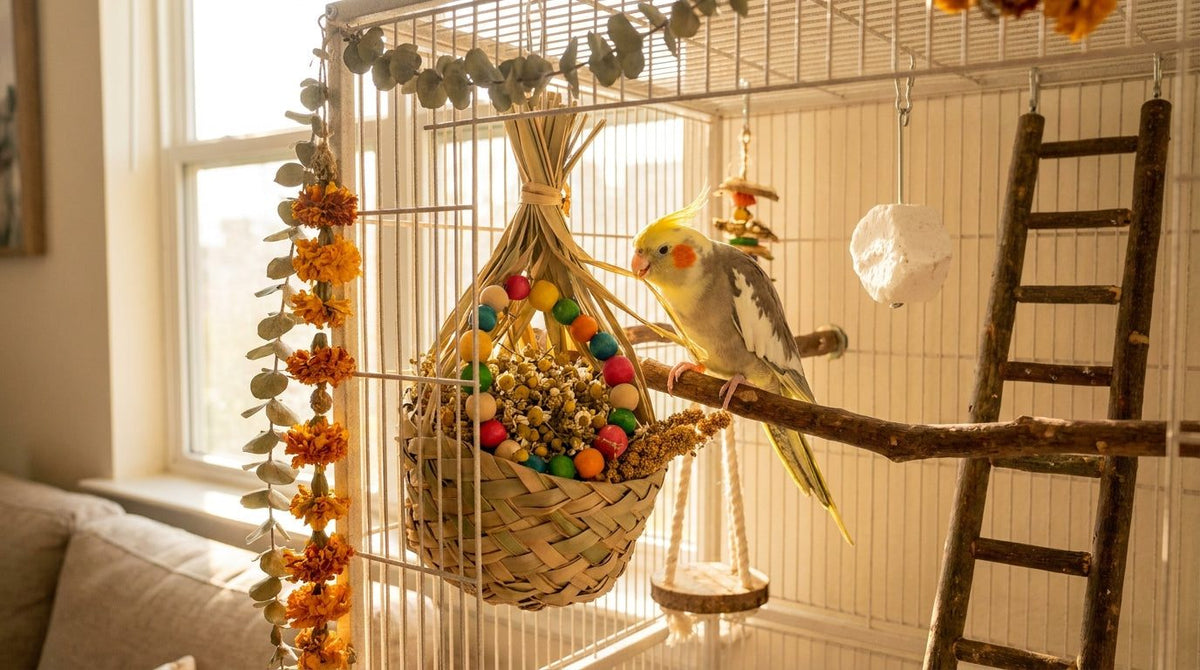
The gold standard. Natural branches vary in diameter, texture, and shape — mimicking wild conditions. Birds can also chew them, satisfying a natural beak-use behavior. Manzanita is dense and long-lasting; softer woods like willow are more chewable and shreddable.
Best for: Primary perching position, main cage perch
Watch for: Outside branches must come from pesticide-free trees; sterilize by soaking overnight in a bleach-water solution, then rinse thoroughly and dry fully before placing in the cage.
Rope Perches (Cotton or Natural Fiber)
Soft and comfortable — ideal for older birds, arthritic birds, or those recovering from foot injuries. The flexibility of rope perches also mimics small, moving branches in the wild.
Best for: Resting relief from harder perches, older or handicapped birds
Watch for: Fraying is the primary hazard — toes and nails can catch in loose threads. Trim frayed ends promptly with scissors. Remove immediately if your bird ingests rope strands — crop impaction is a life-threatening risk.
Sandy/Textured Perches
These help passively maintain nail length and stimulate blood flow in the feet. However, the coarse texture is too abrasive for long-term contact.
Best for: Food bowl areas where the bird perches briefly; secondary position only
Do not use as a main sleeping perch — prolonged contact with abrasive texture causes sores.
Platform / Shelf Perches
Flat surfaces give feet a complete rest from gripping. Particularly valuable for birds with arthritis, bumblefoot, or mobility limitations.
Best for: Resting platform, toy play area, a place to stretch feet flat
Tip: Corner shelf perches install easily and give birds an elevated, secure vantage point they naturally seek.
Wooden Dowel Perches
Uniform diameter and smooth surface — the least beneficial perch type. No variation means no foot exercise; the smooth surface increases fall risk during sleep.
⚠️ Avoid as a primary perch. If you must use a dowel (e.g., for a bird with certain foot conditions), use it as a secondary option only. As BirdTricks notes: "I do not recommend wooden dowel perches because of their uniformity in size and shape. They do nothing to exercise the feet."
⚠️ Also avoid cement/concrete perches as primary perches. Some have tested positive for lead content. If used for nail trimming, limit contact time and position them at food bowl areas only.
How Many Perches?
-
Minimum 3 perches per cage in different positions: high, mid-level, and one near food/water
-
Vary diameter — the highest perch (where birds sleep) should have the most comfortable, best-fitting diameter for your specific bird
-
No perch directly above another — droppings contaminate lower perches and food dishes
Foraging Toys: The Single Most Important Accessory {#foraging-toys}

If you could only add one category of bird cage decoration, foraging toys deliver the most behavioral and psychological benefit of any accessory.
The AAV's enrichment framework specifies that foraging enrichment must simulate three stages: (1) searching for food, (2) procuring it, and (3) extracting or processing it. A bowl of food only satisfies stage 3. Foraging toys engage all three — which is why they transform idle, potentially destructive behavior into purposeful, satisfying activity.
Types of Foraging Toys
| Toy Type | How It Works | Difficulty Level |
|---|---|---|
| Foraging baskets/boxes | Food hidden inside woven palm or rattan; bird must pull apart to access | Beginner |
| Shreddable toys | Paper, palm leaf, cork, soft wood — bird shreds to explore/destroy | Beginner |
| Puzzle feeders | Sliding doors, turning wheels, removable caps hide food | Intermediate |
| Food kabob/skewer | Fresh produce or treats threaded on a stainless skewer; bird must pull, tear, and bite | Beginner–Intermediate |
| Foraging wheel | Rotating chambers with hidden treats; bird manipulates to find food | Intermediate–Advanced |
| Paper foraging rolls | Treats wrapped in paper layers; bird unwraps each layer | Beginner |
Best Practices for Foraging Toys
-
Start simple — birds new to foraging may not understand the concept immediately. Place visible food partially inside the toy first, then increase difficulty gradually.
-
Rotate weekly — novelty is part of the value. A familiar toy loses its foraging challenge quickly.
-
Don't overfill the cage — Red Bluff Animal Hospital advises: "Too many at once can overwhelm your pet." Two to three active toys at a time, rotated regularly, is more effective than a cluttered cage.
-
Use food as the motivator — place a portion of your bird's daily food ration inside foraging toys rather than always in the bowl. This is the single most impactful way to increase enrichment time.
Swings, Ladders & Climbing Accessories {#swings-ladders-climbing}
Swings are among the most universally popular bird cage decorations — and for good reason. They provide movement, balance practice, and a satisfying perch option that mimics the gentle sway of a natural branch in a breeze.
The AAV notes that rope perches with mild movement — "boings, swings, and bungees" — simulate movement on natural tree branches and help birds practice balance.
| Accessory | Benefit | Best Placement |
|---|---|---|
| Rope swing | Balance, movement, comfort | Upper mid-cage; away from walls |
| Wooden bead swing | Chewing + swinging combined | Upper area, ample clearance |
| Rope ladder | Climbing, exercise, transition between levels | Connecting two perch heights |
| Rope climbing net | Full-body movement, grip strength, bridge between areas | Spanning cage sections or connecting play area |
| Boing (spiral rope perch) | Bouncy movement, full-body engagement | Hung vertically from cage top |
| Wooden platform perch | Rest, play surface, vantage point | Mid-high level, corner position |
Sizing note: Swings and ladders must fit your bird's size. A budgie on a macaw-sized swing cannot grip properly; a large parrot on a toy-sized swing creates both a safety and a comfort problem.
Cuttlebone, Mineral Blocks & Beak Health {#cuttlebone-mineral-blocks}
Cuttlebone and mineral blocks belong in every bird cage — not as optional extras, but as functional accessories with direct health implications.
Cuttlebone delivers:
-
Calcium — essential for bone health, egg production in females, and nerve function
-
Beak conditioning — the abrasive texture passively polishes and trims the beak as birds peck
-
Behavioral outlet — pecking and scraping is a natural behavior that cuttlebone satisfies safely
Mineral blocks complement cuttlebone with additional trace minerals (iodine, magnesium, sodium) that a pellet-and-seed diet may not fully cover.
As Red Bluff Animal Hospital notes: "Cuttlebones don't just help your bird's beak — they're a natural calcium source that supports bone health and egg-laying in females."
Placement: Clip the cuttlebone to the cage bars at mid-height on the cool side of the cage — accessible but not directly above food or water dishes. Replace when it's been substantially consumed or shows mold.
Food & Water Dishes: Material and Placement {#food-water-dishes}
Not all dishes are equal — and poor dish material or placement is one of the most common sources of bacterial exposure in bird cages.
Material
| Material | Safety | Notes |
|---|---|---|
| Stainless steel | ✅ Best | Non-porous, dishwasher-safe, bacteria-resistant, durable |
| Ceramic / crockery | ✅ Good | Heavy and stable; check for lead-free glaze |
| Plastic | ⚠️ Caution | Cracks and scratches harbor bacteria; birds often chew plastic |
| Galvanized metal | 🚫 Avoid | Zinc content poses heavy metal toxicity risk |
Always choose stainless steel or ceramic for food and water dishes. Wash daily with hot water and bird-safe soap; replace water twice daily in warm weather.
Placement
-
Position food dishes just above perch height — this minimizes contamination from droppings falling in
-
Never place food dishes directly below a perch — droppings land in the food
-
Place water on the coolest, least-trafficked side of the cage to slow bacterial growth
-
Use clip-on or bolt-on style dishes — birds will tip free-standing dishes, creating mess and depleting water supply
Bathing Supplies {#bathing-supplies}
Regular bathing maintains feather condition, supports skin health, and provides behavioral enrichment. Most birds enjoy water interaction — though individual preferences vary widely between species and individuals.
Options for in-cage bathing:
-
Shallow bath dish — a wide, low-sided ceramic or stainless dish placed on the cage floor or clipped to the bars; fill with 1–2 cm of lukewarm water
-
Misting bottle — a clean, dedicated spray bottle filled with plain water; mist gently from above to simulate light rain; many birds respond by spreading wings and preening actively
-
Shower perch — a suction-cup perch for the shower; allows birds to bathe in gentle lukewarm water alongside their owner; particularly loved by larger parrots
Never use soap, shampoo, or scented products — plain lukewarm water only. Scented products and essential oils are respiratory hazards for birds. The AAV also notes that leaf bathing behavior can be encouraged by hanging large, misted edible leaves (kale, Swiss chard) horizontally inside the cage.
Sleep Covers & Comfort Accessories {#sleep-covers}
Birds need 10–12 hours of darkness and quiet per night for proper rest and hormonal regulation. Light exposure beyond that disrupts sleep cycles, affects mood and reproductive hormones, and contributes to chronic stress.
A breathable cage cover — sized to cover all but one side for airflow — addresses this directly. Choose:
-
100% cotton or natural fiber fabric — breathable and non-toxic if chewed
-
Dark color — blocks light effectively
-
Machine-washable — cage covers accumulate dust and dander rapidly
Avoid polyester or synthetic blends — if a bird chews the cover and ingests synthetic fibers, intestinal obstruction is a risk.
What's Safe vs. What's Toxic: The Materials Guide {#safe-vs-toxic-materials}

This is the most critical section of any bird cage decoration guide. Heavy metal toxicity is one of the most common — and most preventable — causes of serious illness and death in captive birds.
Safe Metals
As BirdTricks' comprehensive metals guide explains:
| Metal | Safety | Notes |
|---|---|---|
| Stainless steel | ✅ Preferred | The gold standard for cages, hardware, dishes, and toy parts |
| Nickel-plated | ✅ Safe | Acceptable for hardware; some sensitivity concerns at high exposure |
| Aluminum | ✅ Safe | Non-toxic oxide; avoid thin sheets a bird can bite into small pieces |
| Chrome-plated | ⚠️ Uncertain | May contain zinc; BirdTricks advises avoiding it when in doubt |
| Galvanized metal | 🚫 Toxic | Zinc-plated; highly dangerous — zinc toxicity is fatal |
| Lead | 🚫 Toxic | Found in old paint, solder, some weights and wires |
| Zinc | 🚫 Toxic | Found in galvanized wire, some cage latches, old pennies |
| Copper | 🚫 Toxic | Pipes, wiring, some decorative hardware |
⚠️ Real toxicity risk: As one BirdTricks reader reported: "A little parrotlet found a zinc fan blade weight and nearly died. We are 5 days into treatment and she still cannot walk or grasp with her talons." Zinc toxicity requires immediate veterinary chelation therapy — prevention through hardware selection is far simpler than treatment.
Safe Woods for Toys & Perches
✅ Safe: Manzanita, dragonwood, java wood, willow, apple, pear, elm, birch, ash, eucalyptus (dried)
🚫 Avoid: Avocado, oak (contains tannins in high quantity), cedar, pine (resinous), cherry (contains cyanide compounds), oleander
Safe Dyes & Colorants
Reputable bird toy manufacturers use vegetable-based or soy-based dyes — these are bird-safe. As BirdTricks notes: "Most dyes are soy-based (vegetable) and are a safe colorant choice." Avoid toys with no disclosed dye information from unverified suppliers. Bright colors are fine — it's the dye source that matters.
Toxic Household Items Near the Cage
Per Best Friends Animal Society:
-
Scented candles and incense — candle wicks contain heavy metals; fumes are respiratory hazards
-
Non-stick (PTFE/Teflon) cookware — overheated non-stick surfaces release fumes lethal to birds, even from another room
-
Air fresheners and aerosols — highly toxic to avian respiratory systems
-
Essential oil diffusers — respiratory hazard; birds have extremely sensitive air sacs
Bird Cage Decoration Placement Tips {#placement-tips}
How you arrange accessories inside the cage is as important as what you choose. Poor placement creates contamination, stress, and injury risk.
Vertical Zone Planning
| Zone | What Goes Here | Why |
|---|---|---|
| Top third (high) | Primary sleeping perch, swing | Birds naturally seek height for safety and rest |
| Middle third | Foraging toys, interactive accessories, secondary perches | Prime activity zone; most time spent here during waking hours |
| Lower third | Bath dish (on floor), cage liner, rarely-used perches | Keep clear of heavy traffic to maintain hygiene |
Horizontal Zone Planning
-
One corner = food/water station — dishes at consistent location reduce stress; birds learn and expect feeding spots
-
Opposite side = activity zone — toys, foraging items, climbing accessories away from eating area
-
Leave flight space — never fill the cage so densely that your bird cannot move between perches freely
Placement Rules
-
No perch above a food or water dish — droppings contaminate food and water
-
Toys at eye level or above for the bird — birds interact with items at or above their head position far more than items below
-
Secure all hooks and clips — quick-links from hardware stores may be zinc-plated; use stainless steel quick-links from avian suppliers only
-
Introduce new items gradually — birds are neophobic (cautious of new things); a sudden complete rearrangement causes stress. Add one new item at a time
Species-Specific Accessory Guide {#species-specific-guide}
| Species | Perch Priority | Favorite Toy Types | Bathing | Notes |
|---|---|---|---|---|
| Budgerigar (Budgie) | Natural wood + rope | Mirrors, bells, shreddable paper, swings | Shallow bath dish, misting | Social; provide mirror or companion |
| Cockatiel | Natural wood + platform shelf | Swings, shreddable toys, foraging baskets | Misting spray, shallow bath | Crests show stress — monitor mood |
| Lovebird | Natural wood + rope | Shreddable paper, nesting materials, swings | Misting, shallow bath | Active wall climbers; horizontal bars essential |
| Conure | Natural wood + rope boing | Shreddable/destructible toys, bells, foraging | Shower perch, misting | Highly active; need durable, destruction-rated toys |
| African Grey | Varied natural wood | Complex puzzle feeders, foraging wheels, rotating toys | Shower perch | Extremely intelligent; needs highest foraging difficulty |
| Cockatoo | Heavy-duty natural wood | Heavy destructible toys, rope boings, foot toys | Shower perch, bathing | Powerful beaks — only stainless steel hardware |
| Canary / Finch | Thin natural perches | Swings, small bells, nest materials | Shallow bath dish | Minimal handling; visual enrichment most important |
Common Accessory Mistakes to Avoid {#common-mistakes}
1. Using sandpaper perch covers Marketed as a nail-trimming solution, sandpaper sleeve covers on perches cause foot sores and skin abrasion. As Red Bluff Animal Hospital states: "Avoid sandpaper-covered perches — they're harsh and can cause sores."
2. Only one perch diameter throughout the cage Uniform perching causes repetitive stress on the same foot muscles and joints, leading to arthritis and pressure sores over time. Vary diameter across every perch in the cage.
3. Buying the largest, most complex toy immediately A bird that has never encountered a foraging toy will ignore or fear an advanced puzzle feeder. Start with simple shreddable or partially open foraging items, then increase complexity as the bird learns.
4. Leaving frayed rope perches and toys in place Frayed rope catches toes and nails — this causes panic, struggling, and potential loss of a toe or nail. Inspect rope accessories weekly; trim or replace when fraying is visible.
5. Using galvanized wire or hardware-store clips Standard hardware store quick-links, snap hooks, and wire mesh are almost always galvanized — zinc-coated. Source all cage hardware from avian-specific suppliers who stock stainless steel components.
6. Never rotating toys A familiar toy loses all foraging and enrichment value within days. Rotation keeps the cage environment novel and mentally engaging. Remove two toys, add two different ones — rotate every 7–10 days.
7. Placing all accessories in the center of the cage Birds use the perimeter and high zones of the cage most. Accessories hung only in the center miss the zones where birds actually spend their time.
The Talis-us Bird Hub Standard {#talis-us-bird-hub}
At Talis-us, every bird cage accessory we carry earns a Talis Curated badge through a defined safety and enrichment standard:
-
✅ Stainless steel hardware only — no galvanized, zinc-plated, or chrome-plated clips, rings, or hooks
-
✅ Bird-safe dyes confirmed — vegetable or soy-based colorants; no undisclosed synthetic dyes
-
✅ Natural, untreated wood — sourced from avian-safe species; no pesticide-treated materials
-
✅ No adhesives or glues — all natural fiber construction where applicable
-
✅ Foraging function included — enrichment toys rated by foraging complexity level (Beginner / Intermediate / Advanced)
-
✅ Species-size matched — accessories listed with compatible species clearly stated
-
✅ AAV enrichment category labeled — each product tagged by which enrichment type it satisfies
Our Bird Care Hub at Talis-us includes species-specific cage setup guides, foraging toy progression programs, and curated starter accessory kits built around the five AAV enrichment categories — so you start with everything your bird actually needs, not just what looks good in a store display.
Final Checklist: Is Your Cage Fully Enriched? {#final-checklist}
Use this to audit your current setup or build a new one from scratch:
Perches ☐
-
Minimum 3 perches of varying diameter, material, and texture
-
One natural wood branch as the primary/sleeping perch
-
One rope or soft-texture perch for rest relief
-
One platform or shelf perch for flat-foot resting
-
No sandpaper perch covers; no smooth dowels as primary perch
-
No perch positioned directly above food or water dish
Foraging & Toys ☐
-
At least 2 foraging toys active in the cage at all times
-
Shreddable toy present (paper, palm leaf, soft wood)
-
Toy rotation schedule: every 7–10 days
-
Foraging difficulty matched to bird's experience level
-
Portion of daily food placed inside foraging toys, not only in bowl
Swings & Climbing ☐
-
Swing or boing present and appropriately sized
-
Ladder or climbing net connecting vertical levels (for active species)
Nutrition & Beak Health ☐
-
Cuttlebone clipped to bars at accessible mid-height
-
Mineral block present and replaced when consumed
-
Food dishes: stainless steel or ceramic only
-
Water dish: stainless steel, changed daily
Safety ☐
-
All cage hardware is stainless steel (no galvanized clips or wire)
-
All toys from reputable avian suppliers with disclosed materials
-
Frayed rope trimmed or removed
-
No candles, aerosols, non-stick cookware, or essential oil diffusers near cage
Comfort ☐
-
Breathable cotton cage cover for 10–12 hours of darkness nightly
-
Bathing option available: dish, misting bottle, or shower perch
-
Cage positioned away from drafts, direct sun, and kitchen fumes
Veterinary ☐
-
Avian vet identified and contact saved before a health problem occurs
-
Annual wellness check scheduled — find an AAV member at aav.org
Always consult a qualified avian veterinarian for species-specific care recommendations. This guide covers general best practices applicable to most common pet bird species. Individual needs vary by species, age, and health status.

Written by Talis Us


Leave a comment
This site is protected by hCaptcha and the hCaptcha Privacy Policy and Terms of Service apply.