


Glass vs. PVC Reptile Enclosures: The Real Differences
Walk into any reptile keeper's home and you'll find strong opinions about enclosure material. Glass terrariums have been the hobby standard for decades. PVC enclosures have surged in popularity over the last several years — and for good reason. But marketing aside, what actually separates these two materials, and which one is right for your animal?
The answer is not one-size-fits-all. It depends on what species you keep, what climate you're trying to replicate, how you heat and humidify your enclosures, and what your long-term husbandry goals look like.
This guide works through every meaningful difference — insulation, humidity, visibility, weight, safety, bioactive compatibility, stress behavior, cost, and species-specific suitability — so you can make a well-informed decision rather than one based on price tag or aesthetics.
Table of Contents
What Is a PVC Reptile Enclosure?
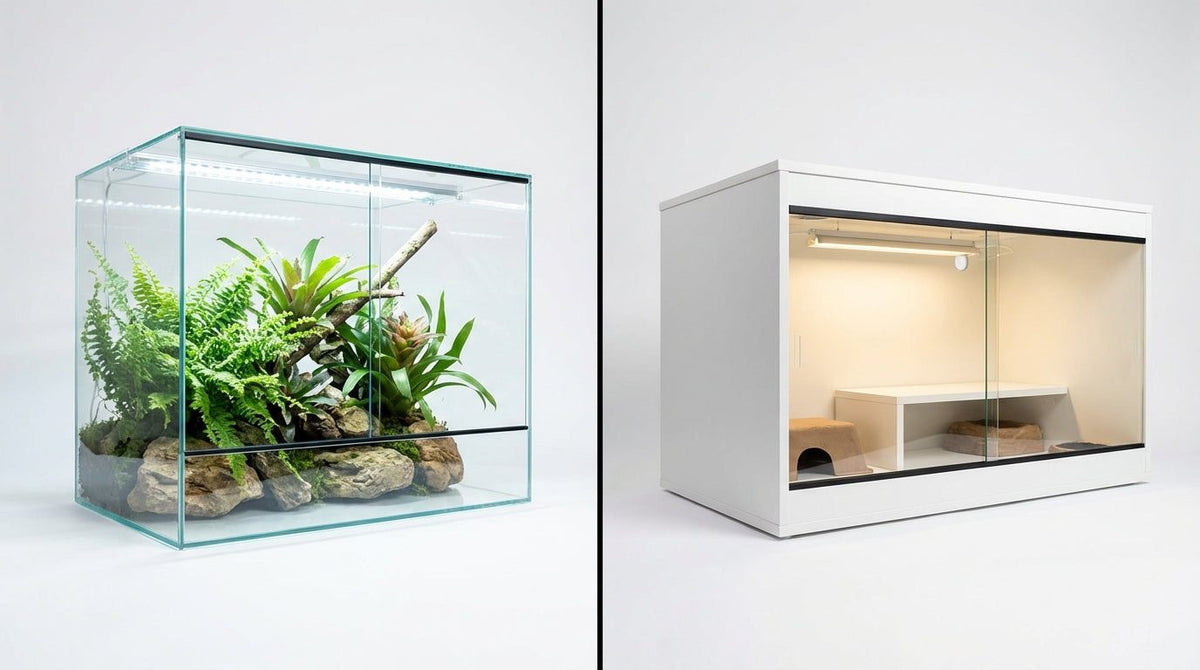
PVC (polyvinyl chloride) enclosures are purpose-built reptile habitats constructed from rigid, high-grade PVC panels — typically with solid sides, a solid top (or top with mesh ventilation strips), and sliding or hinged tempered glass doors at the front. The PVC panels provide strong thermal insulation, moisture resistance, and structural durability.
Modern PVC enclosures are generally manufactured with:
-
Solid opaque sides and back (often white or black)
-
Front-opening tempered glass doors (sliding or magnetic)
-
Integrated top ventilation slots or mesh sections
-
Front substrate lips that contain deep substrate layers
-
Optional built-in grommet ports for wiring and equipment
Popular PVC enclosure brands in the current market include Zen Habitats, Kages, REPTI ZOO PVC, and various custom fabricators. PVC enclosures are available in sizes ranging from small 20-gallon equivalents to custom 8-foot+ modular units for large monitors and tegus.
What Is a Glass Reptile Terrarium?
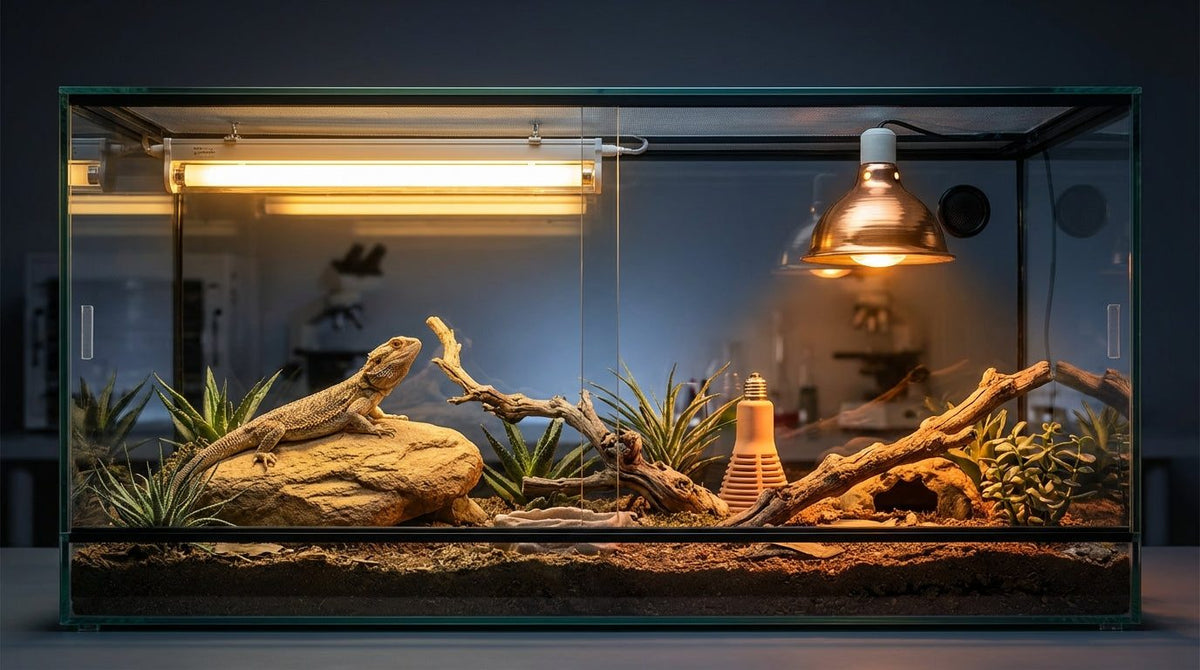
Glass terrariums are the traditional reptile enclosure format — four or five transparent glass walls, typically with a screen mesh top and front-opening doors (or a removable lid for top-loading designs). Some modern glass terrariums use tempered safety glass and feature dual front-opening doors, raised bottoms for substrate depth, and integrated overflow channels for bioactive setups.
Common glass terrarium brands include Exo Terra, Zoo Med (ReptiBreeze), REPTI ZOO glass, and Zilla. Glass terrariums range from small 10-gallon aquarium repurposes to purpose-built 120-gallon-equivalent vivarium setups.
The glass terrarium's key selling points are unobstructed 360-degree (or three-sided) visibility, clear UVB light transmission, and a lower upfront price point for standard sizes.
Thermal Insulation and Temperature Stability
This is the most functionally significant difference between the two materials — and where PVC and glass diverge most sharply.
Glass is highly thermally conductive. Heat energy moves through glass relatively easily, meaning the warmth your basking lamp and heating elements generate inside the enclosure continuously bleeds out through the glass walls into the surrounding room. The result: your heater and thermostat have to work harder and cycle more frequently to maintain target temperatures. On cold nights or in cold rooms, glass enclosures can experience significant ambient temperature drops. (Stumps Custom Wood)
PVC has significantly lower thermal conductivity. PVC panels behave more like insulation than like a window — they trap heat inside rather than transferring it outward. The practical effect: your heating elements and thermostat do less work, temperature gradients remain more stable throughout the day and night cycle, and your basking zone-to-cool zone differential is easier to maintain precisely. (Toxirium)
For ectothermic animals — which includes every reptile — stable, predictable temperature gradients are not a convenience. They directly affect digestion efficiency, immune response, activity levels, and metabolic function. A basking zone that fluctuates by 10°F due to poor enclosure insulation produces a meaningfully different health outcome than one held at a consistent target temperature.
Practical implications for keepers:
-
In glass: use higher-wattage basking bulbs, insulate the back and sides with foam board, and expect more active thermostat cycling
-
In PVC: appropriately sized heat sources are often lower wattage; dimming thermostats are critical because PVC holds heat so effectively that oversized heaters can overheat the enclosure
-
Glass in cold rooms or drafty spaces requires extra compensation; PVC performs more consistently across variable ambient conditions
Humidity Control: The Chimney Effect vs. Sealed Systems

Humidity management is the issue that pushes the most tropical-species keepers from glass to PVC — and the physics behind it is straightforward.
The chimney effect in glass tanks: Most glass terrariums use a screen mesh top. Heat naturally rises, carries moisture with it, and escapes through the mesh continuously. This creates a relentless cycle where humidity leaves the enclosure faster than passive moisture sources can replenish it. Keepers of ball pythons, blood pythons, green tree pythons, chameleons, and many tropical lizards frequently describe glass humidity management as a constant battle — involving wet towels over the screen, aluminum foil patches, and misting systems running at high frequency just to maintain 60–70% RH. (Toxirium)
PVC's sealed construction: PVC enclosures are closed systems — solid panels on all non-viewing sides, with small, controlled ventilation slots rather than open mesh tops. This design allows humidity to build and hold without constant evaporative loss. A ball python enclosure in PVC, properly set up, can maintain 65–80% RH with a single weekly water change and minimal misting — compared to the same enclosure in glass requiring daily intervention. (Stumps Custom Wood)
When glass humidity is appropriate: Not all species need high humidity. Desert species — bearded dragons, leopard geckos, uromastyx, blue-tongued skinks — require 30–40% RH. For these animals, glass's natural tendency toward air exchange and evaporation is functionally appropriate, not a problem. A glass terrarium with screen top ventilation naturally prevents the humid stagnation that would harm a desert-adapted reptile.
Key health consequences of incorrect humidity:
-
Too low: retained shed (dysecdysis), dehydration, respiratory mucosal dryness
-
Too high (without adequate airflow): bacterial and fungal growth, respiratory infection, mold in substrate
-
Neither glass nor PVC is universally "right" — matching the enclosure's passive humidity behavior to the species' requirements is the goal
Visibility, Light Transmission, and UVB
Glass holds a clear advantage when visibility and light transmission are priorities.
Glass clarity: High-quality glass terrariums provide true optical clarity — unobstructed, undistorted views of the animal and its environment from multiple angles. This is valuable for observation, photography, display setups, and bioactive builds where the planted interior is a feature in itself. Glass does not scratch, cloud, or yellow over time the way some plastics do.
UVB transmission through glass: Standard glass blocks 100% of UVB (as covered in detail in our UVB lighting guide). This is not a practical problem for enclosures where UVB bulbs are mounted inside the enclosure — which is the correct setup regardless of material. UVB from a tube mounted inside a glass terrarium reaches the animal exactly as it would in a PVC enclosure. The only scenario where this matters is if you were attempting to use sunlight through a glass wall as a UV source — which doesn't work and should not be attempted.
PVC viewing panels: Most PVC enclosures compensate for opaque sides by using high-quality tempered glass front doors. Quality builders use true glass (not acrylic) for the viewing panel — which resists scratching and maintains long-term clarity. The sides and back are intentionally opaque, which serves an important animal welfare function (discussed below).
Mesh and UVB blocking: Screen mesh tops block 25–45% of UVB output depending on wire gauge and gap size — this applies to glass terrariums with mesh tops. Account for mesh block factor when positioning UVB tubes in glass tanks, or when calculating what UVI your animal receives at basking level. (LafeberVet)
Animal Stress and the "Open Glass" Problem
This is an underappreciated factor in enclosure material selection, particularly for species that exhibit "glass surfing" — the behavior of repeatedly rubbing or pressing against enclosure walls.
360-degree transparency causes stress in many species. When a reptile can see activity, movement, and light from all four sides of its enclosure, it cannot establish a secure territory or feel protected. Many reptiles — especially snakes, but also skittish lizards — will chronically display stress behaviors in all-glass enclosures: pacing, nose rubbing, frantic movement, reduced feeding, and hypervigilance. This is not a behavior problem; it is the animal's appropriate response to feeling exposed.
PVC's opaque sides mimic natural shelter. The solid back and side panels of a PVC enclosure create a visual boundary that most reptiles respond to as a burrow, cave, or dense vegetation wall — a secure retreat. Reptiles housed in PVC enclosures consistently show reduced defensive behavior, improved feeding response, and more relaxed resting posture compared to identical animals transitioned from all-glass setups. (Toxirium)
Partial mitigation for glass terrariums: Applying an opaque background to three sides of a glass tank — cork tile sheets, foam background panels, or even vinyl film — substantially reduces the visual exposure problem. This is a widely used and effective workaround. It doesn't solve the insulation or humidity challenges, but it does address the behavioral stress component.
Species that are most affected:
-
Ball pythons, boa constrictors, and most colubrids (defensive/secretive by nature)
-
Skinks and monitors (territorial animals that react to their own reflection)
-
Sensitive tropical species like chameleons
Species that are less affected:
-
Bearded dragons and blue-tongued skinks (bolder, more display-oriented temperament)
-
Leopard geckos (provide hides and they'll self-regulate)
-
Display animals with habituation to human presence
Weight, Portability, and Stackability

This difference is most relevant to keepers with multiple animals, breeders, or anyone who moves enclosures regularly.
Glass weight: A 40-gallon glass terrarium weighs approximately 55 lbs empty. A 120-gallon equivalent (the adult bearded dragon minimum) can weigh 100+ lbs. Moving, cleaning, or repositioning large glass enclosures is a two-person job — and dropping one is both a safety hazard and an expensive loss. Glass cannot be stacked without heavy-duty reinforced shelving systems.
PVC weight: A 4'×2'×2' PVC enclosure typically weighs 30–40 lbs — roughly half to one-third the weight of an equivalent glass setup. Most PVC enclosures are manageable by a single person. More practically: quality PVC enclosures are designed to be stackable directly on each other, with integrated support bars rated for 100 lbs. Stacking 3–4 PVC enclosures in a column creates a high-density animal housing arrangement that would require purpose-built, reinforced shelving to replicate in glass. (Toxirium)
For breeders and multi-animal keepers: PVC's weight and stackability advantages are significant. Rack systems using PVC are the industry standard in breeding operations for good reason — modularity, weight management, and space efficiency.
Durability, Maintenance, and Longevity
Glass durability: Tempered glass — used in quality modern terrariums — is significantly stronger than standard glass and shatters into small, relatively less hazardous pieces rather than large shards. However, it remains breakable under impact, and the frames and seals of glass terrariums can degrade over time with repeated cleaning or moisture exposure. A broken glass panel on a quality terrarium often requires professional repair or full unit replacement.
PVC durability: PVC resists impact, does not shatter, and maintains structural integrity through repeated cleaning and humidity cycling. Minor surface scratches on PVC can often be addressed with repair compounds or sanding. PVC panels are generally chemically resistant to reptile-safe disinfectants — including dilute bleach solutions, F10SC, and similar cleaners used in reptile husbandry. (Stumps Custom Wood)
PVC limitation — heat deformation: PVC can warp or deform if heat sources are placed incorrectly or without thermostatic control. Radiant heat panels, ceramic heat emitters, and basking bulbs must be properly positioned with clearance from PVC walls, and always used with a calibrated thermostat. This is not unique to PVC — all enclosure materials have heat management requirements — but it is worth noting.
Cleaning comparison:
| Task | Glass | PVC |
|---|---|---|
| Routine wipe-down | Easy (non-porous surface) | Easy (non-porous surface) |
| Disinfection | Standard disinfectants | Most reptile disinfectants compatible |
| Water spots/mineral deposits | More visible on clear glass | Less visible on opaque panels |
| Substrate deep clean | Manageable | Manageable |
| Repair if damaged | Often full replacement needed | Panel repair or localized fix often possible |
Bioactive Enclosure Compatibility
Both glass and PVC can host bioactive setups — but they suit different biome types.
Glass for bioactive tropical builds: Glass terrariums are a popular choice for bioactive vivaria because their visibility makes the planted interior a display feature. The high transparency also provides better ambient light penetration for live plants. Deep-bottom glass terrariums (Exo Terra, Zoo Med Natural Terrariums) have raised bottoms specifically designed to hold drainage layers and deep substrate. However: managing the humidity demands of a tropical bioactive setup in a glass enclosure requires more active intervention — frequent misting, partial mesh cover, or sealed lids — to offset the chimney effect.
PVC for bioactive humid setups: PVC's sealed construction is a natural match for the sustained high humidity that tropical bioactive setups require. Ball pythons, boa constrictors, blood pythons, and many burrowing species thrive in PVC bioactive enclosures because the stable humidity supports both the animal and the live plant/microfauna ecosystem. The substrate lip on most PVC enclosures supports 4–6 inches of substrate depth without spill — important for fossorial species and healthy bioactive soil layers.
Glass for bioactive arid builds: Low-humidity desert bioactive setups (leopard geckos, bearded dragons, uromastyx) are highly compatible with glass terrariums. The natural air exchange keeps humidity in the range these animals require, while the visibility lets the keeper monitor the cleanup crew and substrate health effectively.
Cost: Upfront vs. Long-Term
| Cost Factor | Glass | PVC |
|---|---|---|
| Upfront purchase | Lower (standard sizes widely available) | Moderate to higher (especially custom) |
| Energy use | Higher (more heater cycling) | Lower (better heat retention) |
| Supplemental insulation | Often needed (foam board, background panels) | Generally not needed |
| Replacement risk | Higher (breakage, seal failure) | Lower |
| Repair cost | Often full replacement | Often partial repair |
| Resale value | Moderate | Moderate to good (branded PVC holds value well) |
| Long-term value | Moderate | Generally favorable for tropical/large setups |
Glass terrariums are typically less expensive upfront for standard sizes — a 40-gallon Exo Terra or Zoo Med can be found for $80–$150, while a comparable PVC enclosure may run $150–$300+. However, once you factor in the cost of additional insulation materials, more powerful heating equipment, and the higher electrical costs of more active heater cycling, the long-term gap narrows or reverses for tropical and large-animal setups. (Stumps Custom Wood)
For desert species in smaller enclosures, glass often remains the better value overall. For large tropical setups or multi-enclosure breeding operations, PVC's long-term operational costs are generally lower.
Complete Comparison Table
| Feature | Glass Terrarium | PVC Enclosure |
|---|---|---|
| Thermal insulation | Poor — high heat loss through walls | Excellent — low thermal conductivity |
| Temperature stability | More variable; heater cycles more | More stable; less heater work required |
| Humidity retention | Challenging (screen tops promote airflow) | Excellent (sealed construction) |
| Visibility | 360° optical clarity | Front-only through tempered glass doors |
| UVB transmission | Blocks 100% — lamps must be inside | Same — lamps must be inside enclosure |
| Animal stress | Higher risk from all-sides transparency | Lower — opaque sides provide security |
| Weight | Heavy (100+ lbs for large tanks) | Lightweight (50% or less of glass) |
| Stackability | Requires reinforced shelving | Integrated stacking support bars |
| Durability | Breakable; seal degradation over time | Impact resistant; shatter-proof |
| Heat deformation risk | None | Possible without thermostat control |
| Bioactive compatibility | Good for arid / display tropical | Excellent for humid tropical |
| Disinfection ease | Easy | Easy |
| Upfront cost | Lower | Moderate to higher |
| Long-term running cost | Higher (energy/replacement) | Lower for tropical/large setups |
| Best for | Desert species, display builds | Tropical/humid species, breeders, large animals |
Species-Specific Recommendations
Choose Glass For:
-
Bearded dragons — Desert species that need open basking, low RH (30–40%), and high visible light. Glass's natural ventilation is an asset.
-
Leopard geckos — Low-humidity requirement; glass works well with adequate hides and partial background coverage.
-
Blue-tongued skinks — Moderate humidity needs that glass can accommodate with partial mesh cover.
-
Chameleons — A complex case: most chameleon specialists recommend screen or hybrid enclosures for ventilation; glass alone creates stagnant air issues. Not ideal as a standalone material.
-
Day geckos and display animals — Glass's visual clarity is a genuine advantage for animals kept as display specimens in naturalistic planted terrariums.
-
Small tropical builds with active humidity management — Glass bioactive terrariums for crested geckos, dart frogs, and anoles can work well if keepers are committed to consistent humidity management.
Choose PVC For:
-
Ball pythons and boa constrictors — The paradigm case for PVC. High humidity requirements (60–80% RH) that glass makes extremely difficult to maintain passively.
-
Blood pythons and other high-humidity pythons — Same humidity requirements; PVC is the industry standard for this group.
-
Green tree pythons and arboreal snakes — Stable humidity and reduced visual stress from opaque walls.
-
Large monitors and tegus — PVC enclosures can be expanded and stacked at scales where glass is not practical or safe.
-
Breeding collections — Weight, stackability, and energy efficiency make PVC the clear choice for multi-animal operations.
-
Any tropical species in a challenging room environment — Cold rooms, dry climates, or drafty spaces amplify glass's insulation weaknesses; PVC compensates.
Either Works Well For:
-
Corn snakes — Moderate humidity, manageable in glass with partial cover; PVC also excellent.
-
Crested geckos — Glass works with active humidity management; PVC simplifies it.
-
King snakes and milk snakes — Lower humidity requirements that glass handles adequately.
Who Should Choose Glass vs. PVC?
Glass is likely the better starting point if:
-
You're keeping a desert or low-humidity species (bearded dragon, leopard gecko)
-
Display and visibility are a priority — planted bioactive terrariums as room features
-
Budget is a primary constraint for a standard-size enclosure
-
You're new to reptile keeping and working with a well-established, commonly kept species
-
You live in a warm, consistently humid environment where ambient conditions support the enclosure's performance
PVC is likely the better choice if:
-
You're keeping any tropical snake, particularly ball pythons, boas, or pythons
-
You've struggled to maintain consistent humidity in glass
-
You keep multiple animals and stackability/space efficiency matters
-
You plan to run bioactive setups for tropical species
-
Your home runs cold or dry in winter — PVC compensates where glass struggles
-
You're building a breeding collection or scaling up your operation
The honest summary: PVC wins on functional husbandry metrics for the majority of tropical and large-species applications. Glass wins on visibility, initial price point, and suitability for arid species and display builds. Neither is universally superior — the best enclosure is the one whose passive material properties align with your species' environmental requirements, reducing the amount of active intervention required to maintain a stable, healthy microclimate.
Browse Talis-us's curated selection of reptile enclosures, heating, and husbandry equipment — all vetted to our Talis Curated standards for quality and species appropriateness.
FAQs
Is PVC safe for reptiles? Yes — reptile-grade PVC is non-toxic and safe when used with properly controlled heat sources and a calibrated thermostat. Quality PVC enclosures use fire-retardant-rated panels. The key safety rule: always use a thermostat with any heat source in a PVC enclosure to prevent heat deformation or overheating.
Can I use a glass terrarium for a ball python? It's possible, but requires active management. Ball pythons need 65–80% relative humidity — a level that glass tanks with screen tops struggle to maintain passively. Keepers who use glass for ball pythons typically cover 75–85% of the mesh top, use a large water dish, and run a fogger or misting system. Switching to PVC significantly simplifies this.
Does glass or PVC affect UVB lighting? Neither material affects UVB delivery when lamps are mounted inside the enclosure — which is always the correct approach. Standard glass and most plastics block UVB, but this is only relevant if you were trying to use exterior UV sources, which isn't a standard or recommended practice.
Can glass terrariums be made more humid with modifications? Yes. Partially covering the screen top with aluminum foil, glass panels, or foam board is a common and effective modification. This reduces air exchange and allows humidity to build. The tradeoff is reduced passive ventilation, so monitoring for mold and bacterial growth in the substrate becomes more important.
Why do ball python keepers switch from glass to PVC so often? Because ball pythons require sustained high humidity, and glass's chimney effect makes that genuinely difficult to achieve without constant active management. Most experienced ball python keepers describe the switch to PVC as the single change that resolved chronic husbandry challenges — retained sheds, respiratory issues, and feeding inconsistency linked to environmental instability.
Are PVC enclosures good for bioactive setups? Yes — PVC is an excellent platform for bioactive humid setups because the stable, high humidity supports both the animal and the live plant/cleanup crew ecosystem. The substrate lip on most PVC enclosures also supports the deep substrate layers bioactive setups require.
What size PVC enclosure do I need for a bearded dragon? The current recommended minimum for an adult bearded dragon is 4'×2'×2' (approximately 120 gallons). While many keepers use glass for bearded dragons successfully, PVC at this size has the advantage of better heat retention for the high basking temperatures (105°F+) bearded dragons require.
This article is for informational and educational purposes. Always consult a reptile-specialist veterinarian or experienced herpetologist for species-specific enclosure recommendations, particularly for animals with specialized environmental requirements.

Written by Talis Us


Leave a comment
This site is protected by hCaptcha and the hCaptcha Privacy Policy and Terms of Service apply.