



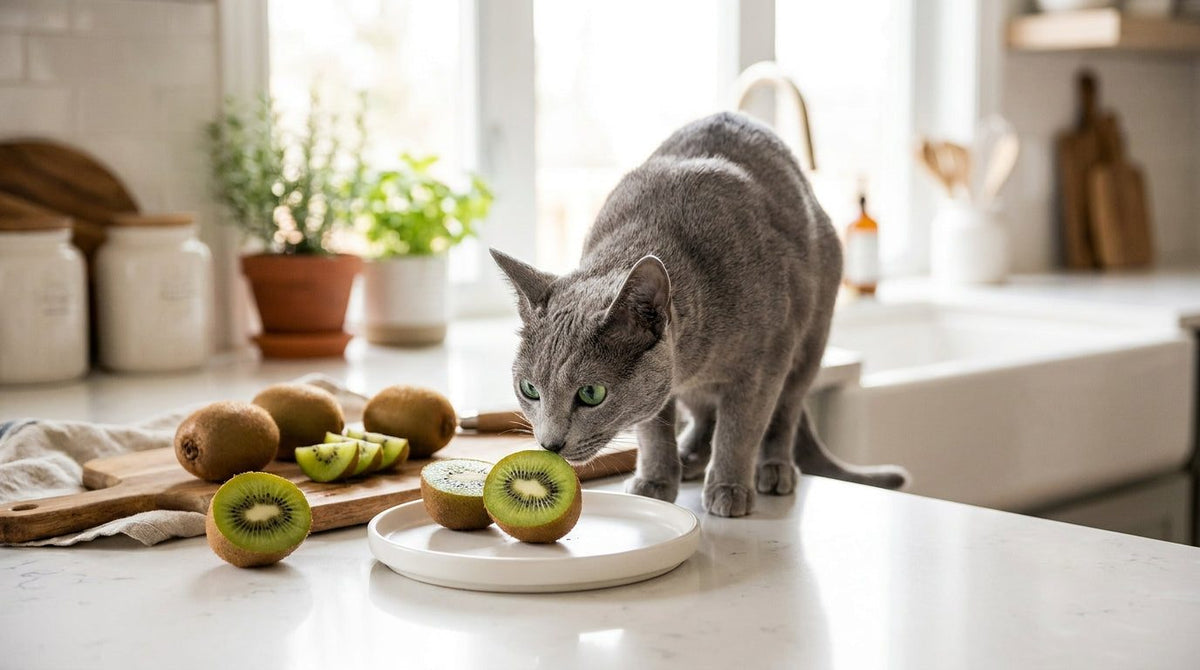
Can Cats Eat Kiwi? The Complete Owner's Guide
Yes — With Important Differences From Dogs You Need to Know
Your cat is watching you peel a kiwi with the same intensity they give a bird outside the window. Can you share a piece? The answer is yes — but cats and kiwi have a more nuanced relationship than dogs and kiwi do. Understanding why requires a quick look at how cats are fundamentally different from every other common pet when it comes to food.
This complete guide covers whether kiwi is safe for cats, what nutritional role (if any) it plays, how to prepare it correctly, how much is appropriate, what to avoid, and — importantly — what cats actually need in their diet for true long-term health.
Table of Contents
Why Cats and Fruit Are Different: The Obligate Carnivore Explained
The Fascinating Reason Cats Don't Even Taste Kiwi the Way We Do
Can Cats Eat Kiwi? The Direct Answer
 Cats can safely investigate — and occasionally eat — small amounts of kiwi. But their relationship with fruit is fundamentally different from a dog's, for biological reasons that are fascinating in their own right.
Yes, cats can eat kiwi in small amounts. Kiwi is not considered toxic to cats. It does not appear on the ASPCA's list of foods harmful to pets, and veterinarians at PetMD confirm it is among the fruits cats can safely consume as an occasional treat.
However — and this is the critical distinction for cat owners — the word "safe" means something different in the context of feline nutrition than it does for dogs or humans. Cats are obligate carnivores, meaning their entire physiology is built around processing animal protein, not plant matter. Fruit offers cats very little nutritional value they cannot already obtain from a quality meat-based diet. Kiwi is safe, but it is genuinely optional for cats in a way it is not for omnivores.
Source: PetMD — What Fruits Can Cats Eat? · The Spruce Pets — What Fruits Can Cats Eat?
Why Cats and Fruit Are Different: The Obligate Carnivore Explained
To understand why kiwi is a far more peripheral part of a cat's diet than a dog's, you need to understand what "obligate carnivore" actually means at a biological level.
Dogs are omnivores — like humans, they evolved to digest and derive nutrition from both animal and plant sources. Over thousands of years co-existing with humans, dogs developed more amylase (the enzyme that digests starch) and broader nutritional flexibility.
Cats are obligate carnivores — their entire metabolic system is optimized for a diet of animal tissue. Key differences:
| Biological Feature | Dogs (Omnivore) | Cats (Obligate Carnivore) |
|---|---|---|
| Primary energy source | Protein, fat, or carbohydrates | Protein and fat only |
| Amylase (starch digestion) | Present in saliva | Absent in saliva; very limited |
| Taurine synthesis | Can synthesize own | Cannot — must get from meat |
| Vitamin A synthesis | Can convert beta-carotene | Cannot convert — needs preformed vitamin A from animal sources |
| Niacin synthesis | Can synthesize from tryptophan | Very limited capacity; depends on meat |
| Glucose regulation | Flexible | Tuned for low-carbohydrate diet; high sugar can cause issues |
| Fruit nutritional benefit | Moderate | Minimal — all key nutrients obtained from meat |
The practical consequence: fruit treats that offer genuine supplemental nutrition to dogs deliver much less incremental benefit to cats, whose premium diet already provides superior versions of every vitamin and mineral fruit contains — in forms cats can actually absorb and use.
Key principle: Kiwi is safe for cats. It is not nutritionally meaningful for cats. These are two different things, and both matter.
Source: The Spruce Pets — Cats and Carbohydrates (citing Vet Sci research) · PetMD — Can Cats Taste Sweet Things?
The Fascinating Reason Cats Don't Even Taste Kiwi the Way We Do
Here is one of the most surprising biological facts about cats: cats literally cannot taste sweetness.
Research published in the Journal of Nutrition confirmed that cats lack a functional T1R2 gene — the gene that encodes one half of the sweet taste receptor present in virtually all other mammals. Without this receptor, cats have no ability to detect or respond to sweet flavors. The sugary taste that makes kiwi appealing to humans and even dogs is completely imperceptible to cats.
What this means practically:
Cats don't seek out fruit the way dogs might — there is no sweet reward signal driving their interest
When a cat does show curiosity about kiwi, it is typically responding to its texture, scent, or the novelty of a new object — not to sweetness
Some cats will sniff kiwi and walk away entirely; others may take a lick or small bite out of curiosity; a small number will develop a genuine preference for it
None of these responses are driven by the same taste motivation that makes kiwi appealing to humans
This is also why cats — unlike dogs — don't typically "beg" for fruit. They are not wired to find it rewarding in the same sensory way.
Source: The Spruce Pets citing Li X et al., J Nutr — "Cats Lack a Sweet Taste Receptor"
Nutritional Profile of Kiwi for Cats
Kiwi does contain real nutrients. Here is how they translate to feline biology:
| Nutrient in Kiwi | Amount per Kiwi (~69g) | Relevance to Cats |
|---|---|---|
| Vitamin C | ~64 mg | ⚠️ Low relevance — cats synthesize their own Vitamin C internally |
| Vitamin K | ~28 mcg | ✅ Supports blood clotting; mild benefit |
| Vitamin E | ~1.1 mg | ✅ Antioxidant; supports skin and immune health |
| Potassium | ~215 mg | ✅ Supports heart and muscle function |
| Dietary Fiber | ~2.1 g | ⚠️ Cats need very little fiber; too much causes GI upset |
| Natural Antioxidants | Present | ✅ Can support immune health in small amounts |
| Natural Sugars | ~9g | ⚠️ Cats cannot efficiently process carbohydrates; limit intake |
| Water Content | ~83% | ✅ Mild hydration benefit |
| Calories | ~42 kcal | ✅ Very low — safe as a tiny treat |
The honest assessment: most of kiwi's celebrated nutritional benefits are calibrated for human (and omnivore) physiology. Cats synthesize their own Vitamin C, have limited need for plant-derived fiber, and lack the metabolic pathways to efficiently use plant-based nutrients the way omnivores do. The genuine minor benefits — potassium, Vitamin K, antioxidants — are real but modest relative to what a quality cat food already provides.
Source: PetMD — What Fruits Can Cats Eat?
Can Cats Eat Kiwi Skin?
No. Always remove the skin before offering kiwi to a cat.
Kiwi skin is tough, fibrous, and difficult for cats to digest. Cats' digestive systems are shorter and more specialized for processing meat than dogs' — meaning the rough, high-fiber kiwi skin is even harder for cats to process than it is for dogs. It can cause:
Digestive upset and GI discomfort
Vomiting
Constipation or loose stools
Potential choking, particularly if a piece is swallowed partially intact
The kiwi skin is not toxic — but it offers nothing beneficial and carries real risks. Always peel completely before serving.
Can Cats Eat Kiwi Seeds?
Yes — kiwi seeds are safe for cats.
The tiny black seeds inside kiwi are not toxic to cats and are small enough that they do not pose a choking hazard. Unlike apple seeds (which contain trace cyanogenic compounds) or cherry pits (which are toxic), kiwi seeds are inert and harmless.
Your cat can consume the seeds along with the flesh without concern.
How Much Kiwi Can Cats Eat? Portion Guide
 The safe preparation protocol for cats: wash, peel completely, slice thinly, serve only 1–2 tiny pieces maximum. Less is always more when it comes to fruit for cats.
Cats require significantly smaller portions than dogs — their digestive tolerance for plant matter is lower, and their caloric needs are generally smaller overall.
General Portion Rule
Treats of all kinds — including fruit — should represent no more than 10% of your cat's total daily caloric intake. For most cats, that is roughly 20–40 calories from treats per day total. Kiwi, at approximately 42 calories per whole fruit, must be given in very small fragments, not as a whole serving.
Practical Portion Guidelines for Cats
| Cat Size | Recommended Kiwi Amount | Max Frequency |
|---|---|---|
| Small cat (under 8 lbs) | 1 very small piece (~½ teaspoon) | Once or twice per week |
| Average cat (8–12 lbs) | 1–2 small pieces (~1 teaspoon total) | Once or twice per week |
| Large cat (over 12 lbs) | 2 small pieces (~1 teaspoon total) | Once or twice per week |
For kittens: Avoid kiwi entirely. Kittens have sensitive, rapidly developing digestive systems and do not need — or benefit from — fruit as part of their diet. Their caloric needs are best met entirely by high-quality, high-protein kitten food.
First introduction: Offer a single tiny piece and monitor your cat for 24–48 hours. Watch for any vomiting, diarrhea, lethargy, or changes in appetite. If any digestive upset occurs, kiwi is not the right treat for that individual cat — and that is perfectly fine.
How to Prepare Kiwi for Cats — Step by Step
Step 1 — Wash the kiwi Rinse thoroughly under cool water to remove any surface pesticides or residue.
Step 2 — Peel completely Remove every trace of the fuzzy outer skin. No skin should remain.
Step 3 — Slice into very thin rounds Cut the peeled kiwi into thin rounds — thinner than you would for a dog.
Step 4 — Dice into tiny pieces Cut each round into small, cat-appropriate pieces — roughly half the size of your fingernail. A cat's mouth and digestive tolerance is much smaller than a dog's.
Step 5 — Offer 1–2 pieces maximum Place the pieces in your cat's bowl or offer by hand. This is a treat, not a meal — keep the total amount very small.
Step 6 — Refrigerate leftovers promptly Store any remaining cut kiwi in an airtight container in the refrigerator. Use within 2 days.
What NOT to Do
❌ Never offer dried kiwi — highly concentrated sugar
❌ Never offer kiwi juice or kiwi-flavored products — added sugar, preservatives, and potentially xylitol (toxic)
❌ Never offer canned kiwi in syrup — excessive sugar
❌ Never leave a whole kiwi accessible — cats may chew the skin or swallow large pieces
Risks and Cautions
🔴 Digestive Upset
Cats' digestive systems are optimized for meat, not plant fiber. Even small amounts of kiwi can cause loose stools, vomiting, or gas in sensitive cats. High fiber intake from fruit is a more significant issue for cats than for dogs.
🔴 High Sugar Content — Diabetic Cats
Kiwi contains natural sugars that cats cannot process efficiently. For cats with diabetes or insulin resistance, kiwi should be avoided entirely. Even small amounts may cause blood glucose fluctuations. Always check with your veterinarian if your cat has any metabolic condition.
🔴 Overweight Cats
Cats prone to weight gain should receive fruit treats very sparingly, if at all. Natural fruit sugars add caloric density without the protein satiety value that supports healthy weight management in cats.
🟡 Individual Digestive Sensitivity
Some cats — particularly those with sensitive stomachs or inflammatory bowel conditions — react poorly to any new food, including safe ones. Introduce kiwi in a single tiny piece and observe before continuing.
🟡 Allergic Reaction (Rare)
Any new food can trigger an allergic response. Signs to watch for include vomiting, diarrhea, excessive drooling, facial swelling, or lethargy. If any of these occur after feeding kiwi, discontinue immediately and contact your veterinarian.
🟢 No Toxicity
Kiwi does not contain compounds that are toxic to cats. It does not cause kidney failure, liver damage, or neurological effects. The risks are digestive and metabolic — not toxic.
Safe Fruits vs. Unsafe Fruits for Cats
 The line between safe and toxic fruit matters enormously for cats. Grapes and citrus are in a different danger category entirely from kiwi — know the difference before sharing any fruit with your cat.
✅ Fruits Safe for Cats (in very small amounts)
| Fruit | Key Benefit for Cats | Prep Required |
|---|---|---|
| Kiwi | Antioxidants, Vitamin K | Peel completely, tiny pieces only |
| Blueberries | Antioxidants, low calorie | Wash, halve for smaller cats |
| Watermelon | Hydration, Vitamins A & C | Remove rind and all seeds |
| Strawberries | Vitamin C, antioxidants | Remove stem and leaves, halve |
| Apple | Fiber, Vitamins A & C | Remove core, seeds, and skin |
| Banana | Potassium, Vitamins B6 & C | Peel, offer tiny slice only |
| Cantaloupe | Beta-carotene — cats attracted to its meat-like scent | Remove rind and seeds |
| Mango | Vitamins A, B6, C | Remove skin and pit entirely |
| Pear | Fiber, Vitamin C | Remove core and seeds |
| Pineapple | Bromelain, Vitamins A & C | Remove skin, core, leaves |
❌ Fruits Cats Must Never Eat
| Fruit | Risk | Severity |
|---|---|---|
| Grapes & Raisins | Tartaric acid — acute kidney failure, even in tiny amounts | 🔴 SEVERE — potentially fatal |
| All Citrus Fruits (lemon, lime, orange, grapefruit) | Essential oils and psoralen — GI and CNS toxicity | 🔴 HIGH |
| Avocado | Persin toxin — vomiting, diarrhea, cardiac damage | 🔴 HIGH |
| Unripe tomatoes / green parts | Solanine — vomiting, tremors, confusion | 🔴 HIGH |
| Cherries | Pits contain cyanogenic compounds; choking | 🔴 HIGH |
| Dried fruit (any kind) | Concentrated sugar, potential preservatives, chewy texture poses choking risk | 🟡 MODERATE–HIGH |
Source: PetMD — What Fruits Can Cats Eat? · The Spruce Pets — What Fruits Can Cats Eat? · ASPCA — People Foods
⚠️ Emergency: If your cat has consumed grapes, raisins, or any citrus fruit with skin/peel in significant amounts, contact your veterinarian or the ASPCA Poison Control Center (888-426-4435) immediately. Do not wait for symptoms.
What Cats Actually Need: Meat-First Nutrition
 The right perspective on kiwi for cats: a tiny occasional supplement alongside a high-quality, meat-first diet — never a primary nutrition source.
The most important nutritional context for kiwi and cats: a cat's foundational health depends almost entirely on the quality of their primary meat-based diet — not on fruit supplements.
Cats require from their daily food:
High protein (30–45%+ on a dry matter basis) from named animal sources — chicken, turkey, fish, lamb, beef
Moderate fat from animal sources
Taurine (an essential amino acid cats cannot synthesize sufficiently — found only in animal tissue)
Preformed Vitamin A (from animal sources — cats cannot convert plant beta-carotene)
Arachidonic acid (an essential fatty acid cats cannot synthesize — found in animal fat)
Minimal carbohydrates — cats have no dietary requirement for carbohydrates and limited ability to process them
High moisture content — cats evolved from desert animals with low thirst drive; wet food significantly supports urinary tract health
A cat eating a complete, balanced, high-quality meat-based diet has essentially all their nutritional needs met before any fruit is ever introduced. Kiwi, for cats, is genuinely a curiosity snack — not a health supplement.
🛍️ Kiwi Country Cat Food: Premium New Zealand Cat Nutrition at Talis-us
Speaking of kiwi and cats in the same sentence — meet the brand that brings New Zealand's finest ingredients (including real kiwifruit) to your cat's bowl: Kiwi Country™.
We carry the full Kiwi Country cat food lineup at Talis-us.com, each carrying our Talis Curated badge for ingredient integrity and species-appropriate nutrition standards.
🥫 Kiwi Country Grain-Free Wet Cat Food — Chicken, Lamb & Beef (24-pack / 3 oz cans)

The gold standard in Kiwi Country's cat lineup. Each can is built around 90%+ real New Zealand meat — no by-products, no artificial additives, no fillers.
| Flavor | Protein | Key Feature |
|---|---|---|
| Chicken | 90%+ cage-free NZ chicken | All life stages including kittens |
| Lamb | 90%+ grass-fed NZ lamb | Sensitive stomach support, coat health |
| Beef | 90%+ grass-fed NZ beef | High protein, joint support |
Every can includes 4% New Zealand Green Mussel — a natural whole-food source of glucosamine, chondroitin sulfate, and omega fatty acids that supports joint mobility and coat condition. The wet stew texture delivers essential moisture that supports urinary tract health — especially important for cats with low natural thirst drive.
🥩 Kiwi Country Grain-Free Dry Cat Food — Lamb & Beef (2.2 lb bags)

For households that prefer dry feeding or a combination approach, Kiwi Country's grain-free dry cat food features:
Real NZ meat as the #1 ingredient
NZ Green Mussel for natural joint support
Kiwifruit as a genuine whole-food ingredient — antioxidants and digestive enzymes in every serving
Flaxseeds, cranberries, and kelp — whole-food superfoods for coat, urinary, and immune health
Grain-free with clean carbohydrates — no wheat, corn, rice, or soy
Available in Lamb and Beef recipes.
🏅 Why Kiwi Country Earns Our Talis Curated Badge for Cats
| Standard | Kiwi Country Status |
|---|---|
| Named animal protein as #1 ingredient | ✅ Every recipe |
| 90%+ real meat content (wet) | ✅ |
| Grain-free formulation | ✅ |
| No artificial colors, flavors, preservatives | ✅ |
| NZ Green Mussel for joint support | ✅ |
| Real kiwifruit included | ✅ |
| Fully traceable NZ sourcing | ✅ |
| Appropriate for all life stages | ✅ |
🛒 Shop Kiwi Country Cat Food at Talis-us →
Frequently Asked Questions
Can cats eat kiwi every day?
No. Even safe fruits should be offered as occasional treats, not daily additions. Daily kiwi would contribute unnecessary sugar and excess fiber to a cat's diet — both of which can gradually disrupt the metabolic and digestive balance cats need. A few times per week at the very most, in the tiny portions outlined above.
My cat showed no interest in kiwi — is that normal?
Completely normal, and arguably expected. Cats cannot taste sweetness, so the sensory appeal that makes kiwi attractive to humans is simply absent for cats. A cat that ignores kiwi is responding entirely appropriately to its biology. There is no nutritional downside to not feeding kiwi to your cat.
Can kittens eat kiwi?
No — avoid fruit for kittens entirely. Kittens have sensitive, rapidly developing digestive systems and their complete nutritional needs are met by high-quality kitten food. Introducing fruit to kittens offers no benefit and risks causing digestive upset at a critical developmental stage.
Is kiwi juice safe for cats?
No. Commercial kiwi juices contain concentrated sugar, often added sweeteners, and preservatives. Even pure kiwi juice delivers concentrated fruit sugar without the beneficial fiber. Cats should only consume plain fresh water alongside their food — not fruit juices of any kind.
Can cats eat golden kiwi?
Yes, golden kiwi carries the same safety profile as green kiwi for cats — same prep rules apply (peel completely, tiny pieces), same tiny portions, same monitoring for digestive sensitivity. Golden kiwi is slightly sweeter with a smoother skin, but the differences are negligible for cats who cannot taste sweetness anyway.
My cat ate a large piece of kiwi with skin — what should I do?
Monitor closely for the next 24 hours for vomiting, diarrhea, lethargy, or loss of appetite. If any symptoms are severe or persist beyond 24 hours, contact your veterinarian. One accidental exposure to a piece of unskinned kiwi is unlikely to cause serious harm but can definitely cause temporary digestive upset.
Final Thoughts
Kiwi is safe for cats — and that is genuinely good news for curious owners who want to share a snack moment with their feline companion. But the honest perspective is equally important: cats are not dogs, and fruit is not a meaningful part of feline nutritional biology. A cat that eats kiwi occasionally in tiny prepared pieces is fine. A cat that never eats kiwi — or has no interest in it — is losing nothing at all.
The most impactful thing you can do for your cat's long-term health is ensure their primary diet is a high-quality, high-protein, meat-first food with adequate moisture and complete nutritional balance. Get that right, and kiwi becomes exactly what it should be for cats: a small curiosity treat, offered occasionally, prepared carefully, and enjoyed for what it is — a tiny New Zealand-flavored moment of novelty.
And if you want the real New Zealand nutrition story for your cat — real kiwifruit, real grass-fed meat, real green mussel — Kiwi Country has you covered. 🥝🐱
🐱 Talis-us.com's cat nutrition hub features vet-aligned, species-appropriate food for cats at every life stage — from kitten to senior. Every Kiwi Country product in our collection carries our Talis Curated badge, verifying ingredient integrity, meat-first formulation, and premium New Zealand sourcing. Shop our full cat collection at Talis-us.com.

Written by Talis Us



Leave a comment
This site is protected by hCaptcha and the hCaptcha Privacy Policy and Terms of Service apply.