


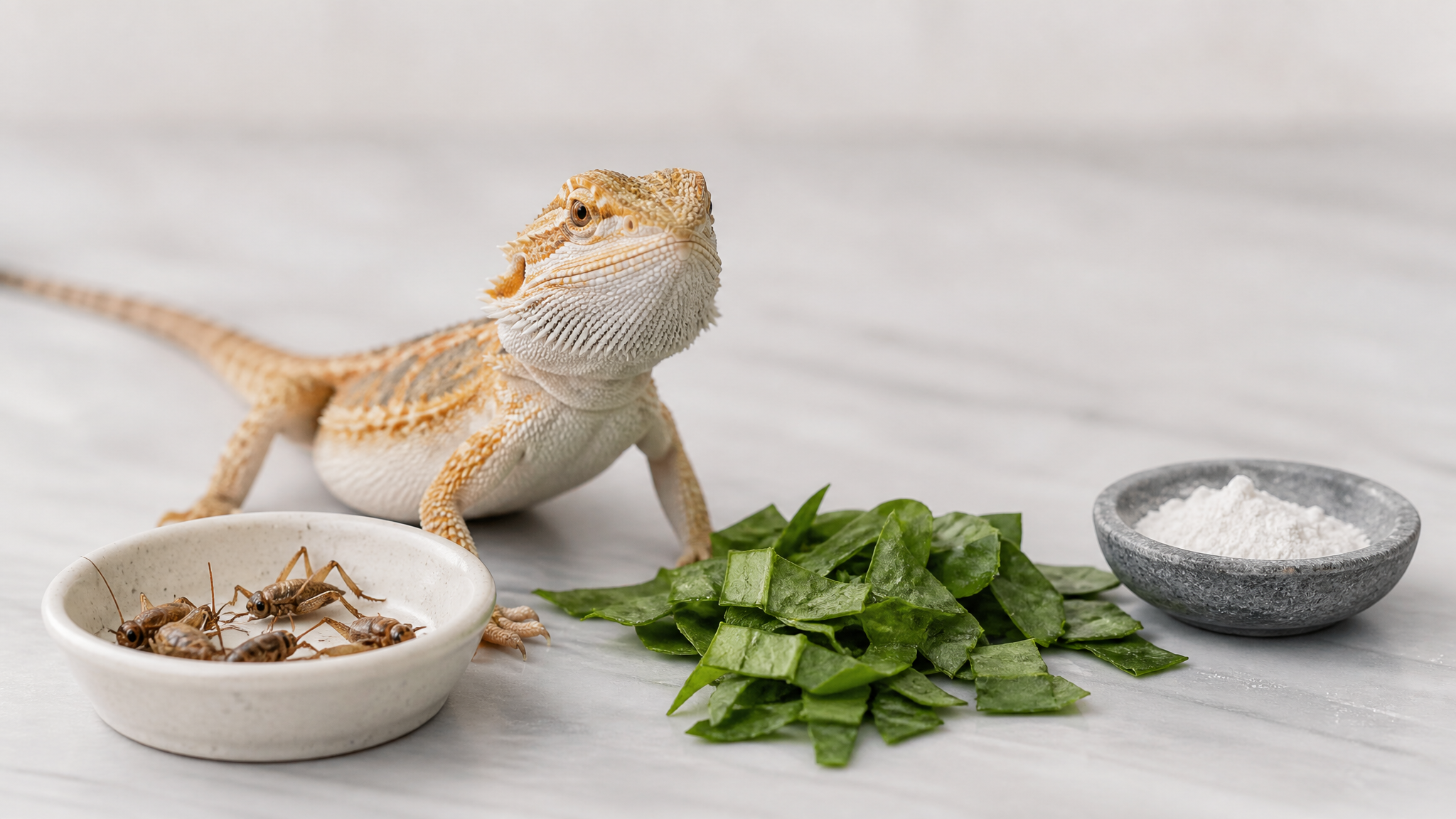
What Do Bearded Dragons Eat Daily? Safe Foods and Portions
What Does a Bearded Dragon's Daily Diet Look Like?
In the wild, bearded dragons are opportunistic omnivores, eating a mix of vegetation and live prey across the arid Australian landscapes they call home. Captive care works best when that balance is replicated, but the precise ratio isn't one-size-fits-all — it shifts with age. A juvenile dragon growing rapidly needs more protein, while an adult built for maintenance leans heavily on plants.
According to reptiledirect.com and beardiehusbandry.com, the adult ratio settles at roughly 70–80% plant matter and 20–30% insects. For juveniles, the split flips — insects dominate the plate. Underpinning any diet plan is the need for calcium absorption, which depends on vitamin D3. VCA Animal Hospitals notes that without adequate D3, even a calcium-rich meal can fall short, leaving a dragon vulnerable to metabolic bone disease. Getting the ratio right and supplementing consistently are the two pillars of a daily routine.
Safe Foods for Bearded Dragons: What the Research Says
Building a daily menu comes down to a few research-backed guardrails: a favorable calcium-to-phosphorus ratio, low oxalate levels, and limited sugar. The sources agree that staple insects and a rotation of leafy greens form the backbone, while fruit is a small, occasional extra. Supplements then fill the gap between captive fare and the nutritional profile of wild prey.
Staple Insects: Protein-Rich Feeders
High-protein, low-fat insects that form the insect portion of the diet include silkworms, NutriGrubs, CalciWorms, and black soldier fly larvae. These feeders earn their staple status partly because they carry a calcium-to-phosphorus (Ca:P) ratio closer to the ideal 2:1, reducing the burden on supplements. Dubia roaches and crickets are the two most commonly compared options. Dubia roaches offer more protein, a better Ca:P ratio, and — a practical edge many keepers appreciate — they cannot climb smooth surfaces, so escapees are less of a headache. Crickets are nutritionally adequate but noisier and more prone to wandering.
Not all insects are built for daily use. Mealworms are avoided for dragons under 12 months due to a hard chitin shell that raises impaction risk. Superworms and waxworms, while tempting, are high in fat and best kept as occasional treats. The source from reptiledirect.com flags these as “feed sparingly” items, not everyday protein.
Leafy Greens and Vegetables: Daily Staples
Low-oxalate, calcium-rich greens to rotate daily include collard, mustard, and turnip greens. The goal is a Ca:P ratio of at least 1:1 (safe daily) and ideally 2:1, as detailed by thebeardeddragon.org. Kale, while nutrient-dense, contains goitrogens that can interfere with thyroid function if fed every day, so the source recommends rotating it in two or three times a week rather than relying on it as a staple. Spinach and beet greens are on the “limit or avoid” list because their oxalate levels exceed the 2mg per 100g threshold — high oxalates bind calcium and make it unavailable, even if the leaf looks healthy.
One thing that strikes keepers is that a dragon’s willingness to eat greens can vary. Offering a mix of textures and occasionally chopping leaves finely can help, but the nutritional foundation remains the same: a base of low-oxalate greens daily, with kale and other goitrogen-containing vegetables in moderation.
Fruits: Occasional Treats Only
Low-sugar fruits as occasional treats, not daily — that’s the consensus from thebeardeddragon.org. Fruit should make up 10–20% of the plant portion, which translates to no more than 5–10% of the total adult diet. Berries, papaya, and melon are safe choices because they fall under the 10g sugar per 100g threshold. Fruits that exceed that mark, like mangoes or grapes, are treat-only and should be offered sparingly.
Acidity matters too. The source defines a pH below 4.25 as a no-go zone — citrus fruits like oranges and lemons land there, and they can cause mouth and stomach irritation. Avocado is entirely off the menu because of persin, a compound toxic to many reptiles. Keeping fruit to a small, rare portion helps avoid sugar-related obesity and digestive upset while still adding variety.
Calcium and Vitamin Supplements: Dusting Schedule
How to dust insects to prevent deficiency: the frequency differs by age. For juveniles, reptiledirect.com advises calcium with D3 five times a week and a multivitamin twice a week. Adults, on the other hand, need calcium without D3 on most feedings (three to four times a week), with a D3-containing supplement once or twice a week, and a multivitamin once a week. The reason captive insects need dusting is straightforward — they lack the calcium-to-phosphorus balance of wild prey, so a light coating of powder bridges the gap.
One odd risk to note: raw egg white contains avidin, which binds biotin and can lead to a deficiency. The source mentions this as a reason to avoid uncooked eggs entirely. A consistent dusting routine, paired with a diet of calcium-rich staples, is the most reliable way to support bone health without guesswork.
Foods and Risks to Avoid for Bearded Dragons
Some foods carry clear, documented dangers. Avocado contains persin, a toxin that can be fatal. Fireflies are perhaps the most acutely dangerous — even one firefly can deliver bufadienolides that cause cardiac arrest. Rhubarb and onions also appear on the toxic list from reptiledirect.com and beardiehusbandry.com due to compounds that can damage organs.
Beyond outright toxins, several foods present a high risk. Mealworms are discouraged for juveniles because their hard chitin can lead to impaction. Pinky mice, while sometimes offered, are high in fat and poor in nutrition for a dragon; raw meat carries a salmonella risk for both the animal and the handler. The source also warns that raw egg white can cause biotin deficiency. A practical rule from the guides: cut all food items no larger than the space between the dragon’s eyes to reduce impaction risk.
Feeding Schedule and Portions by Age
Portion sizes and mealtime frequency aren’t static — they shift as a dragon matures. The source-reported schedules offer a clear framework, but individual appetite and seasonal changes can nudge the routine, so a keeper’s eye is just as important as the clock.
Baby and Juvenile Bearded Dragons (Under 12 Months)
Daily insect feedings and gradual introduction of greens define the juvenile stage. The ratio is 70–80% insects and 20–30% plants, with insects offered two to three times a day. Mealworms are avoided entirely, and safe staples like silkworms and CalciWorms take center stage. The dusting schedule is heavier: calcium with D3 five times a week and a multivitamin twice a week, as reported by reptiledirect.com. A young dragon’s rapid growth makes this consistency critical, but it’s also a window where offering greens early — even if they’re ignored at first — builds a habit for later.
Adult Bearded Dragons (12+ Months)
A plant-heavy diet with insects three to four times a week is the adult norm. The ratio settles at 70–80% plant matter and 20–30% insects. Fruit is limited to 5–10% of the total diet, and the sugar threshold (over 10g per 100g) keeps most fruits in the occasional category. The dusting schedule relaxes: calcium without D3 on most insect feedings, with D3 added once or twice a week, and a multivitamin once a week. This is the phase where keepers often notice a dragon’s palate shifting — some become stubborn about greens, which is where the next section comes in.
Troubleshooting Reluctant Eaters
Strategies to encourage eating when dragons refuse greens or insects start with timing. Offering greens first thing in the morning, when the dragon is hungry and the basking lights have been on for 30–60 minutes, can make them more appealing. If insects are refused, temporarily removing the insect bowl and waiting a day often nudges a dragon to sample the greens. Beardiehusbandry.com notes that appetite dips in spring can be hormonal and temporary, so a few days of reduced eating isn’t necessarily a red flag. For dragons resisting the shift to fewer insects, gradually reducing portion size and frequency over several weeks — rather than a sudden cut — tends to work better.
Frequently Asked Questions About Bearded Dragon Diet
Can bearded dragons eat fruit every day?
No, fruit is a treat due to high sugar. The source limits fruit to 10–20% of the plant portion, and most fruits exceed the 10g sugar per 100g threshold, making daily feeding risky for obesity and digestive health.
What vegetables should bearded dragons eat daily?
Daily staples: collard, mustard, and turnip greens. These have a favorable calcium-to-phosphorus ratio and low oxalates. Kale is rotated in two or three times a week to avoid goitrogen buildup, per thebeardeddragon.org.
How often should I dust insects with calcium?
Dusting frequency depends on age. Juveniles need calcium with D3 five times a week. Adults get calcium without D3 on most insect feedings (three to four times a week) and with D3 once or twice a week, as reported by reptiledirect.com.
Why is my bearded dragon not eating greens?
Common reasons include overfeeding insects, offering greens at the wrong time, or a seasonal appetite dip. Try greens first in the morning and remove insects if refused; a temporary hormonal shift in spring may also be a factor.

De Talis Us




Dejar un comentario
Este sitio está protegido por hCaptcha y se aplican la Política de privacidad de hCaptcha y los Términos del servicio.