


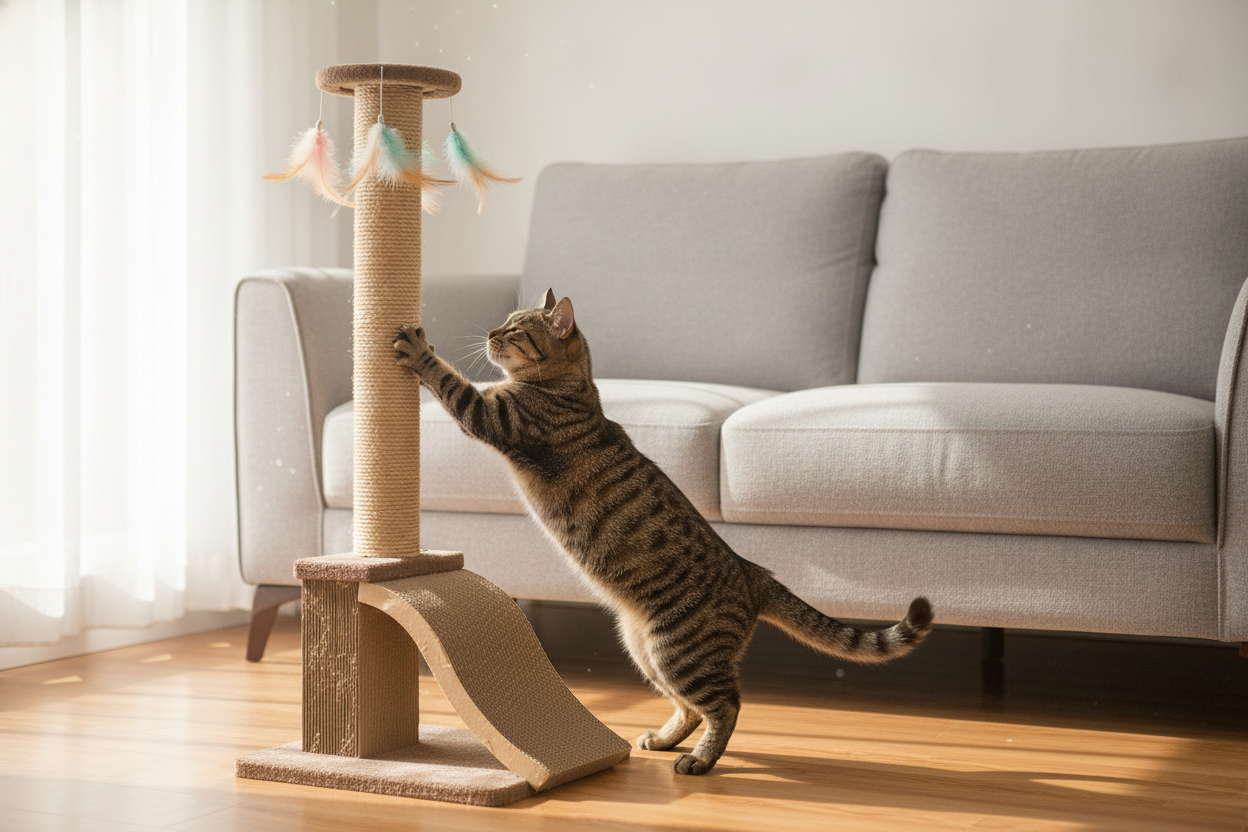
Interactive Cat Scratching Toys That Save Your Furniture
Is Your Sofa Your Cat's Favorite Scratching Post?
You're definitely not alone. Countless cat owners have come home to shredded armrests, frayed couch corners, and claw marks that no slipcover can fully hide. The frustration is real, but here's the good news: the problem isn't your cat's behavior. It's simply that your cat hasn't found a better option yet.
This guide is for cat owners who want to protect their furniture without punishing their pets for doing something completely natural. By understanding what drives your cat to scratch and choosing the right interactive cat scratching toy, you can redirect that energy toward something your cat will genuinely love. Your couch will thank you.
Why Cats Scratch (And Why You Can't Just Say No)
Before you can solve the problem, it helps to understand it. Scratching isn't destructive behavior in your cat's mind. It's essential, instinctive, and deeply satisfying.
The Natural Instinct Behind the Damage
Cats scratch for several important reasons. First, scratching helps them shed the outer sheath of their claws, keeping them sharp and healthy. Second, it's a physical and emotional release. When your cat is anxious, overstimulated, or simply full of energy, scratching provides genuine stress relief. Third, cats have scent glands in their paws, so every scratch leaves behind a territorial marker that says, "This is mine."
When you understand these motivations, it becomes clear why simply saying "no" or moving your cat away from the couch rarely works. The urge to scratch doesn't go away. It just gets redirected, usually back to the nearest piece of furniture.
The real solution is to give your cat an outlet that satisfies all of those instincts at once. That's exactly what a well-designed interactive cat scratching toy is built to do. Rather than suppressing a natural behavior, you're channeling it somewhere productive and appealing.
What Makes an Interactive Cat Scratching Toy Actually Work
Not all scratching toys are created equal. If you've tried a basic cardboard scratcher and watched your cat walk right past it on the way to the sofa, you already know this. The difference between a toy your cat ignores and one they obsess over often comes down to a few key design features.
Features to Look For
Texture variety is one of the most important factors. Cats have strong preferences for how a scratching surface feels under their paws. Some prefer the rough, satisfying drag of sisal rope. Others love the shredding sensation of corrugated cardboard. A few are drawn to carpet-like textures. If you're not sure what your cat prefers, a toy that combines multiple textures or a brand that offers variety gives you the best chance of finding the right match.
Engaging movement transforms a passive scratcher into a genuinely interactive experience. Toys that incorporate dangling feathers, spinning attachments, or motion-activated elements tap into your cat's predatory instincts. When scratching leads to play, your cat gets both physical exercise and mental stimulation, making the toy far more rewarding than a static piece of furniture.
Durability and stability matter more than most people expect. A toy that tips over, slides across the floor, or falls apart after a few sessions will quickly lose your cat's interest. Look for scratching toys with weighted bases, non-slip bottoms, or designs that allow your cat to really lean into the scratch without the toy giving way.
Size and orientation also play a role. Some cats prefer to scratch vertically, stretching their full body upward. Others like to scratch horizontally, lying flat or crouching low. Ideally, you want a toy that accommodates your cat's preferred posture, since a mismatch in orientation is one of the most common reasons cats reject a scratcher.
Placement is a factor that often gets overlooked. Cats tend to scratch in visible, high-traffic areas because part of the behavior is about marking and communication. Tucking a scratcher in a corner your cat never visits is unlikely to be effective. Position it near the furniture your cat currently targets, and over time, you can gradually move it to a more convenient location.
Top Cat Toys That Double as Furniture Savers
Once you know what to look for, the right toy becomes much easier to identify. Here's a look at the types of interactive cat scratching toys that consistently earn high marks from both cats and their owners.
Matching the Right Toy to Your Cat's Personality
For the high-energy kitten: Young cats need constant stimulation. Look for a combination scratcher and wand toy, or a turntable-style toy that incorporates a ball track alongside a sisal scratching surface. These designs keep kittens engaged through multiple types of play in a single product, making them an excellent value and an effective deterrent for furniture damage.
For the curious, intelligent adult cat: Cats that get bored easily benefit from toys with interactive elements they can manipulate. Scratching lounges with built-in puzzle components, or toys that respond to movement with sound or spinning parts, keep clever cats mentally engaged. When a toy challenges your cat, it becomes a preferred activity rather than a last resort.
For the laid-back senior cat: Older cats often appreciate comfort as much as stimulation. A wide, low-profile cardboard scratcher with a gentle incline is easy on aging joints while still satisfying the urge to scratch. Many senior cats also enjoy catnip-infused scratchers, since the scent adds an extra layer of appeal without requiring intense physical activity.
For the territorial cat: If your cat seems to scratch primarily to mark their space, placement and scent become your most powerful tools. Choose a tall sisal post that allows full vertical stretching, and position it in a prominent area your cat already considers theirs. Some cats respond well to scratchers that have been lightly rubbed with catnip or a pheromone spray to make the new toy feel immediately familiar and inviting.
For multi-cat households: When more than one cat shares a space, competition for resources can intensify scratching behavior. Having multiple scratching options in different rooms reduces conflict and ensures every cat has access to an appropriate outlet. Variety in texture and height also helps, since different cats in the same home often have different preferences.
A practical tip worth remembering: when you introduce a new interactive cat scratching toy, spend a few minutes engaging your cat with it directly. Use a wand or a treat to draw their attention to the surface, and reward any interaction with the toy positively. Cats learn quickly when something is associated with a good experience, and that initial introduction can make all the difference in whether the toy becomes a favorite.
Give Your Cat a Better Option, and Your Furniture a Break
The right interactive cat scratching toy gives your cat something they'll genuinely choose over your sofa. It satisfies their instincts, supports their physical and emotional wellbeing, and turns a frustrating habit into a healthy routine. The key is matching the toy to your cat's personality, placing it strategically, and giving your cat a little encouragement to make the switch.
Redirecting scratching behavior doesn't require strict discipline or constant supervision. It just requires understanding what your cat actually needs and offering something that delivers it.
At Talis Us, we believe that happy cats make for happy homes. Explore our cat toy collection to find the perfect interactive scratcher for your companion, whether they're a bouncy kitten, a curious adult, or a wise and relaxed senior. The right toy is out there, and your furniture is counting on you to find it.

De Talis Us


Dejar un comentario
Este sitio está protegido por hCaptcha y se aplican la Política de privacidad de hCaptcha y los Términos del servicio.