


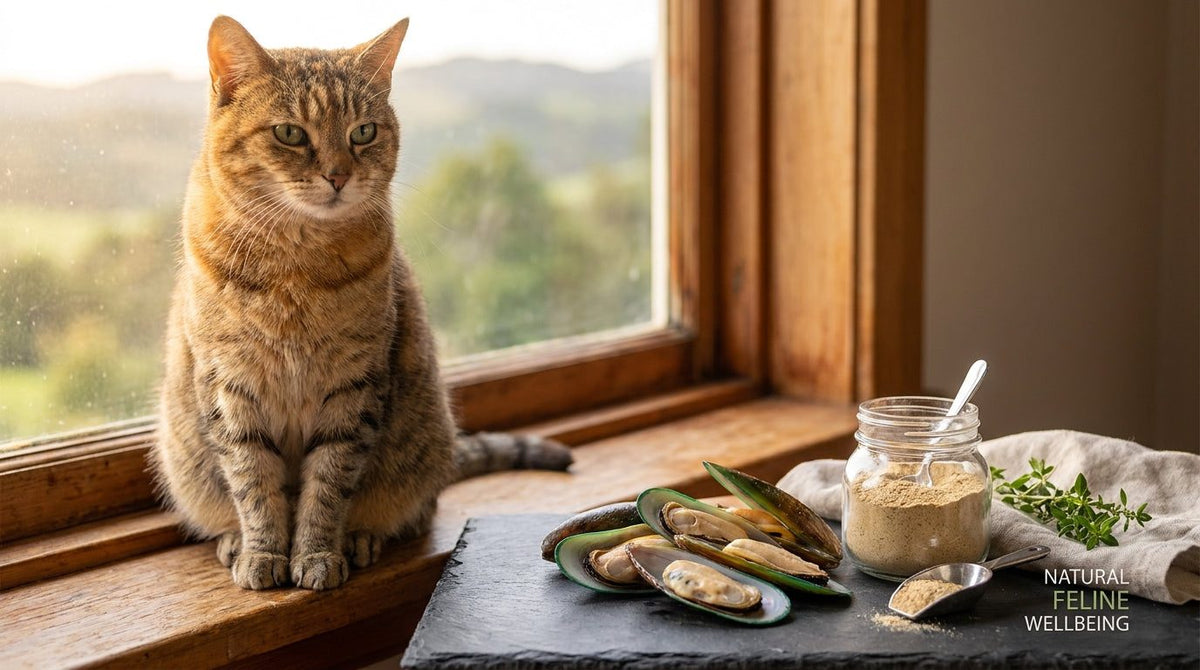
Green Lipped Mussel for Cats: The Complete Vet-Referenced Guide
How This New Zealand Superfood Addresses Feline Joint Disease — the Silent Condition Affecting Most Senior Cats
Cats are famously private about pain. They don't limp dramatically, they don't cry out, and they rarely signal discomfort in ways that are easy to read. Instead, they quietly stop jumping to their favorite window perch. They groom less, sleep more, and become a little more withdrawn. By the time most cat owners notice something is wrong, joint disease may already be well advanced.
This is why feline osteoarthritis is one of the most underdiagnosed and undertreated conditions in companion animal medicine — and why the limited tools available for managing it safely in cats are so important to understand. Green lipped mussel (Perna canaliculus) is one of those tools: the only natural supplement with a peer-reviewed, double-blinded randomized controlled trial conducted specifically in cats, showing objective improvements in mobility in cats with degenerative joint disease.
Here is the full picture.
Table of Contents
What Is Green Lipped Mussel?
 Green lipped mussel (Perna canaliculus), native exclusively to New Zealand's coastal waters, is the only natural supplement with a randomized controlled clinical trial showing objective mobility improvements specifically in cats with joint disease.
Green lipped mussel (Perna canaliculus) is a species of shellfish found only in the pristine coastal waters of New Zealand — it cannot be sourced from anywhere else in the world. Its name comes from the distinctive emerald-green rim along the outer edge of its shell. It has been a staple food of New Zealand's indigenous Māori people for centuries, and it was the observation that coastal Māori had notably lower rates of arthritis than inland or European populations that first drew scientific attention to its anti-inflammatory properties in the early 1970s.
Since then, over 150 peer-reviewed publications have investigated green lipped mussel's therapeutic properties, covering osteoarthritis, asthma, inflammatory disease, and joint health across multiple species — including a dedicated clinical trial in cats.
Green lipped mussel is farmed sustainably on rope lines in New Zealand's clean coastal waters, filter-feeding on natural marine algae without the need for antibiotics, growth hormones, or artificial feed additives — making it one of the most sustainably and transparently sourced marine supplements available.
Why Cats Are Different: The Feline Arthritis Problem
Feline osteoarthritis (OA) and degenerative joint disease (DJD) are far more prevalent than most cat owners realize — and far harder to manage than the equivalent condition in dogs.
The Prevalence Numbers
| Age Group | Estimated Radiographic DJD Prevalence |
|---|---|
| Cats over 6 years | ~33% show radiographic changes |
| Cats over 10 years | ~61–90% show radiographic changes |
| Cats over 12 years (geriatric) | Up to 90% show evidence of DJD on X-ray |
(Sources: Hardie et al. 2002, JAVMA; Clarke et al. 2005, Veterinary Record; Godfrey DR 2005, Journal of Small Animal Practice — cited in FDA Animal Health Literacy)
Despite these figures, the disease is systematically under-recognized. In a study of 28 cats with confirmed osteoarthritis, fewer than half limped — the sign most owners associate with joint pain — while nearly three-quarters showed reluctance to jump and two-thirds jumped shorter distances than before. Cats mask pain exceptionally well.
The Treatment Gap — A Critical Difference from Dogs
Managing joint pain in cats is substantially more challenging than in dogs, for one key reason: no veterinary NSAIDs are currently FDA-approved for safe, long-term pain control from osteoarthritis in cats. Cats are uniquely sensitive to NSAID side effects — including kidney damage, gastrointestinal ulceration, and liver toxicity — at doses that are routine in dogs. Meloxicam, carprofen, and other canine NSAID standbys cannot be used long-term in cats.
This treatment gap makes nutritional and nutraceutical interventions not just complementary in cats — they are often the primary available long-term tool. Green lipped mussel sits at the top of the evidence list for exactly this reason.
Source: FDA — Osteoarthritis in Cats: More Common Than You Think (updated 2025)
Signs Your Cat May Have Joint Disease
 Feline joint disease is often invisible to owners. Unlike dogs, cats rarely limp — they quietly modify their behavior, reduce activity, and withdraw. Learning to read the subtle signs is essential for early intervention.
Because cats actively suppress outward pain signals, recognizing feline joint disease requires watching for behavioral and lifestyle changes rather than the physical lameness that alerts dog owners.
Behavioral Changes That Suggest Joint Pain
| What You Observe | What It May Indicate |
|---|---|
| No longer jumping to a favorite high spot | Elbow, hip, or shoulder joint pain making the jump too costly |
| Jumping but landing awkwardly or with a thud | Reduced spring power from hind leg or hip joints |
| Reduced or absent grooming of difficult areas | Reaching the spine, base of tail, or flanks is painful |
| Using litter box less reliably | Stepping over the litter box wall is too uncomfortable |
| Sleeping in one spot much more than usual | Moving hurts; finding a position that doesn't is a priority |
| Increased irritability or reluctance to be touched | Handling painful joints causes aversion; this is pain response |
| Reduced play engagement | Play requires explosive movement that hurts |
| Spending more time on floor-level surfaces | Avoiding climbs that require joint effort |
| Weight loss without diet change | Chronic pain activates inflammatory pathways that increase catabolism |
⚠️ Veterinary note: If you recognize several of these changes in your cat — especially a cat over 7 years old — a veterinary examination including X-rays is the appropriate first step. Many of these signs have multiple potential causes. A diagnosis of DJD or OA guides the management plan. Green lipped mussel is a complementary nutritional intervention — not a substitute for diagnosis.
Why Green Lipped Mussel Suits Cats Especially Well
This is a point often overlooked: green lipped mussel is not simply a joint supplement that happens to be safe for cats. Several of its properties make it particularly well-suited to feline biology.
1. Marine-Sourced, Animal-Protein Matrix
Cats are obligate carnivores — their digestive systems evolved to derive nutrients exclusively from animal sources. Unlike plant-based anti-inflammatory supplements (turmeric, boswellia, flaxseed), green lipped mussel is a whole marine animal food. Its compounds are delivered in an animal-protein matrix that cats can readily absorb and utilize — without the conversion inefficiencies that limit plant-based omega-3s in cats.
2. Cats Cannot Convert Plant Omega-3s
Cats lack the enzyme delta-6-desaturase at sufficient levels to convert plant-derived ALA (alpha-linolenic acid, found in flaxseed oil) into the EPA and DHA their bodies require. They must obtain EPA and DHA directly from animal marine sources. Green lipped mussel provides EPA, DHA, and the unique ETA omega-3 in their preformed, ready-to-use marine form — exactly what the feline metabolism requires.
3. Fills the NSAID Gap
Because safe, long-term NSAID use is unavailable for most cats with chronic joint disease, green lipped mussel's COX-inhibiting ETA compound and anti-inflammatory omega-3 profile offer a pharmacologically meaningful — and evidence-backed — alternative pathway for reducing joint inflammation without the associated risks.
4. Kidney-Friendly Anti-Inflammatory
Chronic kidney disease (CKD) is extremely common in senior cats, and NSAIDs are generally contraindicated in cats with reduced kidney function. Omega-3 fatty acids from marine sources — including those in green lipped mussel — have been studied for potential kidney-protective and anti-inflammatory effects in cats with CKD. While green lipped mussel is not a kidney disease treatment, its safety profile for cats with concurrent joint disease and kidney concerns is far more favorable than NSAIDs.
5. Palatability
Marine shellfish flavors are highly palatable to most cats. Powder-form green lipped mussel mixed into wet food is typically well accepted, even by selective eaters.
The Active Compounds: What's Inside
 Green lipped mussel delivers a synergistic combination of compounds cats cannot efficiently source from plant-based supplements — all in a marine animal-protein matrix perfectly aligned with feline biology.
Green lipped mussel's therapeutic power comes from a multi-compound, whole-food matrix — not a single isolated ingredient. The key components and their mechanisms:
ETA (Eicosatetraenoic Acid) — Exclusive to Green Lipped Mussel
The most distinctive bioactive in Perna canaliculus, ETA is an omega-3 fatty acid found in no other known food or supplement source. ETA inhibits both cyclooxygenase (COX) and lipoxygenase (5-LOX) — two key enzyme pathways in the inflammatory cascade. This dual-pathway inhibition is the same mechanism targeted by NSAIDs, but without the gastrointestinal and renal side effects. In cats — where NSAID use is heavily restricted — this is particularly significant.
EPA + DHA
Standard long-chain omega-3 fatty acids with well-documented anti-inflammatory effects. Because cats cannot convert ALA to EPA/DHA from plant sources, obtaining these in preformed marine form is essential. Green lipped mussel provides both in a bioavailable marine lipid matrix.
Glucosamine & Chondroitin Sulfate
Naturally occurring in green lipped mussel in whole-food form. Glucosamine supports cartilage synthesis and joint fluid quality; chondroitin inhibits the enzymes that break down cartilage. Both are building blocks of joint structure that decline with age and DJD progression.
Polysulfated Glycosaminoglycans (PSGAGs)
Complex carbohydrate molecules that form the structural matrix of joint cartilage and synovial fluid. They support joint lubrication, shock absorption, and tissue repair — and are found naturally in green lipped mussel without requiring the injectable form (Adequan) that is sometimes used in clinical settings.
Carotenoids & Antioxidants
Green lipped mussel contains fucoxanthin and other marine carotenoids with antioxidant properties that help reduce oxidative stress in inflamed joint tissue — an additional mechanism of benefit beyond the omega-3 and glycosaminoglycan pathways.
Furan Fatty Acids (F-Acids)
A class of bioactive compounds unique to marine shellfish, including green lipped mussel, with emerging evidence of anti-inflammatory gene regulation activity. Research into F-acids and their specific mechanisms is ongoing.
Source: PMC — Greenshell™ Mussels: Veterinary Trials Review, Eason et al. 2018
The Science: The Landmark Feline Clinical Trial
Green lipped mussel has a dedicated peer-reviewed clinical trial conducted specifically in cats — making it one of the few natural joint supplements with species-specific clinical evidence for feline use.
The Lascelles et al. 2010 Study — NC State University
Publication: Journal of Veterinary Internal Medicine, 2010 Institution: Comparative Pain Research Laboratory, North Carolina State University College of Veterinary Medicine Lead Researcher: Dr. B. Duncan X. Lascelles — one of the world's leading veterinary pain specialists
Study Design:
-
40 client-owned cats with confirmed degenerative joint disease (DJD) — radiographic evidence of joint disease AND manipulation-elicited pain response in at least one appendicular joint
-
Randomized, controlled, blinded, parallel-group, prospective clinical study
-
Test diet: High EPA and DHA content + green lipped mussel powder extract + glucosamine/chondroitin sulfate
-
Duration: 9 weeks (70 days)
-
Dose: 4 mg/kg/day green lipped mussel extract component
Outcome Measures (three independent systems):
-
Subjective owner assessments (behavioral questionnaires)
-
Semi-objective veterinary assessments (clinic examinations)
-
Objective activity monitoring — accelerometry (wearable activity sensors measuring real-world movement)
Results:
-
Activity declined significantly (P < .001) in the control diet group over 9 weeks
-
Activity increased significantly (P < .001) in the test diet (GLM) group
-
The difference between groups was statistically significant (P < .001)
-
EPA and DHA plasma concentrations were significantly elevated in the test diet group, confirming absorption
Conclusion (verbatim from abstract):
"A diet high in EPA and DHA and supplemented with green-lipped mussel extract and glucosamine/chondroitin sulfate improved objective measures of mobility. Dietary modulation might be one method to use to improve mobility in cats with DJD-associated pain."
This study is notable for using objective accelerometry rather than relying solely on owner or veterinary impressions — the gold standard for measuring real-world activity changes in cats.
Supporting Evidence — Veterinary Review (2018)
A comprehensive review of all veterinary trials involving green lipped mussel in cats, dogs, and horses — published in Veterinary Sciences by researchers at New Zealand's Cawthron Institute — confirmed that the addition of green lipped mussel to animal diets "alleviated feline degenerative joint disease and arthritis symptoms" across available studies. The review noted that effective doses in animals ranged from 4–49 mg/kg/day depending on extract formulation.
Source: PMC — Greenshell™ Mussels: A Review of Veterinary Trials, Eason et al. 2018
Benefits Beyond Joints
Green lipped mussel's bioactive profile supports several additional aspects of feline health:
🐾 Coat & Skin Health
The preformed EPA and DHA in green lipped mussel support the skin's lipid barrier, reduce inflammatory skin conditions, and contribute to coat luster. This is particularly beneficial in senior cats whose coat condition often declines alongside joint health. Because cats cannot convert plant ALA into EPA/DHA effectively, marine omega-3 sources like green lipped mussel are one of the most efficient ways to deliver meaningful omega-3 skin support.
🫀 Heart Health
Taurine and omega-3 fatty acids together support feline cardiac health. While green lipped mussel is not a taurine source (complete taurine supplementation must come from meat-based diet), its EPA and DHA content contributes to heart muscle membrane function and may support cardiovascular health in aging cats.
🧠 Cognitive Support in Senior Cats
DHA is a primary structural component of brain cell membranes. Adequate preformed DHA intake is associated with maintained cognitive function in aging animals. For cats showing early signs of feline cognitive dysfunction (FCD) — disorientation, nighttime vocalization, altered sleep patterns — ensuring DHA availability through marine sources is one component of a supportive nutritional plan.
🦷 Oral Inflammation
A 2025 PubMed-indexed study specifically investigated green lipped mussel oil in cats with feline chronic gingivostomatitis (FCGS) — a severe inflammatory oral condition. The study, published in a peer-reviewed veterinary journal, investigated omega-3-enriched lickable treats including green lipped mussel oil and krill oil as adjunctive therapy, with results on cytokine modulation.
💧 Hydration and Kidney Support When Delivered in Wet Food
When green lipped mussel is incorporated into wet/canned food (as in Kiwi Country cat food), the high moisture content supports urinary tract health and kidney function — particularly important in senior cats where concurrent DJD and CKD are common.
Dosage Guide for Cats
 Green lipped mussel for cats is available as fine powder (most common), mussel oil drops, soft treat form, or incorporated into premium cat food. Powder mixed into wet food is typically best accepted.
Cats require smaller doses than dogs due to their lower body weight. The landmark Lascelles et al. 2010 clinical trial used 4 mg/kg/day of green lipped mussel extract component. General veterinary supplementation guidance:
| Cat Weight | Daily Dose (powder/extract) | Notes |
|---|---|---|
| Under 5 lbs | ~100–150 mg | Kittens; very small cats |
| 5–9 lbs | ~150–250 mg | Average adult cat range |
| 10–14 lbs | ~250–350 mg | Larger adult cats |
| 15+ lbs | ~350–500 mg | Large or overweight cats |
Note: Dosages vary by product formulation and extract concentration. Always follow the manufacturer's weight-based guidelines for the specific product and consult your veterinarian for your cat's individual needs.
Dosing Tips for Cats
-
Mix powder into wet food — the seafood flavor is typically well-accepted; wet food masks the texture better than dry
-
Start at half dose for the first week to assess individual tolerance
-
Consistency is essential — benefits accumulate over 6–8 weeks; sporadic use produces limited results
-
Do not mix with hot food — heat degrades the omega-3 compounds, particularly ETA; let food cool to room temperature first
-
For very selective cats — mussel oil drops (liquid form) can be easier to incorporate invisibly into food
Forms: Powder, Oil, or In Food?
| Form | Pros | Cons | Best For |
|---|---|---|---|
| Powder | Precise dosing; most widely available; best value; easy to mix into wet food | Slight seafood odor | Most cats; owners feeding wet or mixed diets |
| Mussel oil (liquid drops) | Highly concentrated ETA content; easy to add drop-by-drop; no texture | More expensive; shorter shelf life after opening | Cats who reject powder texture; maximum ETA delivery |
| Soft treats / pill pockets | Convenient; no measuring; palatable | Less dose control; higher sugar/starch sometimes present | Cats who take treats easily and enjoy chews |
| In premium cat food | Seamless daily delivery; no separate supplementing step; wet food moisture benefit | Inclusion rate fixed; cannot adjust dose independently | Owners preferring diet-based supplementation; Kiwi Country cat food customers |
| Freeze-dried whole mussel | Maximum whole-food bioavailability; all compounds intact | More expensive; less widely available in cat-appropriate sizing | Maximum joint support; whole-food-focused owners |
Critical Processing Note for Cats
Just as with dogs, processing method matters significantly. Heat processing destroys green lipped mussel's beneficial activity — particularly ETA and other labile lipid fractions. This was confirmed in the Cawthron Institute veterinary review. Choose products that are freeze-dried, cold-processed, or specify low-temperature processing. Avoid products that list green lipped mussel but do not disclose the processing method, as high-temperature extrusion can reduce efficacy substantially.
How Long Until It Works?
Green lipped mussel works by progressively reducing inflammatory signaling and supporting joint tissue health — it is not an immediate analgesic. The clinical trial in cats ran for 9 weeks (70 days), with measurable objective improvements across the supplementation period.
| Timeline | Expected Changes |
|---|---|
| Week 1–2 | Supplement integrates into systemic circulation; no obvious behavioral changes yet |
| Week 2–4 | ETA and omega-3s begin reducing inflammatory mediators; glucosamine and chondroitin supporting joint fluid quality |
| Week 4–6 | First behavioral improvements may become visible: slightly more willing to jump, more active at certain times of day |
| Week 6–9 | Meaningful activity improvements measurable; peak early benefits in clinical studies observed at this stage |
| Ongoing | Continued daily supplementation maintains anti-inflammatory effect and joint structural support; cartilage-protective benefits are cumulative |
Allow at least 8 weeks of consistent daily use before evaluating effectiveness. The most common reason green lipped mussel "doesn't work" for a cat is that supplementation was discontinued before the therapeutic window was reached.
Safety and Side Effects in Cats
Green lipped mussel has a well-established safety profile in cats when given at recommended doses. The Cawthron Institute veterinary review confirmed no adverse effects at doses ranging from 4–49 mg/kg/day across animal studies, and in rats, doses up to 2–8 g/kg/day showed no ill effects — indicating a wide margin between effective and potentially toxic doses.
Minor Possible Side Effects (Rare)
-
Mild gastrointestinal upset in the first few days — typically resolves on its own or with dose reduction
-
Soft stools during the first week of supplementation
Contraindications and Precautions
| Situation | Guidance |
|---|---|
| Shellfish allergy | Do not use. Signs: vomiting, facial swelling, skin reaction, respiratory distress. Discontinue immediately and contact vet. |
| Concurrent NSAID use | Inform your vet — while green lipped mussel may allow NSAID dose reduction, this should be managed professionally |
| Cats on blood-thinning therapy | High omega-3 intake has mild antiplatelet effects; discuss with vet |
| Pre-surgical | Inform your vet of any omega-3 supplementation before any planned procedure |
| Severe CKD | Omega-3s are generally well-tolerated in CKD cats, but total dietary composition should be managed by your vet |
Can You Give Too Much?
At recommended weight-appropriate doses, overdosing does not present significant toxicity risk. Excessive intake beyond guidelines may cause loose stools. The substantial margin between effective doses and any observed adverse effect dose makes this one of the more forgiving natural supplements available for cats.
How to Choose a Quality Product
| Quality Indicator | What to Look For |
|---|---|
| Species | Certified New Zealand Perna canaliculus — the only species with documented veterinary evidence |
| Processing | Freeze-dried or cold-processed — preserves ETA and the full bioactive lipid fraction |
| Single-ingredient or clean formula | 100% green lipped mussel or clearly disclosed complementary ingredients; avoid unnecessary fillers |
| Dosing transparency | Clear mg-per-serving disclosure so you can dose accurately by weight |
| Third-party testing | Independent verification of omega-3 content and absence of heavy metals or marine contaminants |
| NASC Quality Seal | National Animal Supplement Council certification for quality manufacturing standards |
| Cat-specific formulation | Cat-appropriate dosing and flavor profile (many dog products have doses far too high for cats) |
Talis Curated Note: At Talis-us.com, we apply our Talis Curated standard to all joint health products — requiring verified New Zealand sourcing, cold or freeze-dried processing, and transparent compound disclosure at species-appropriate doses. Browse our vet-aligned feline joint health collection at Talis-us.com.
🛍️ Kiwi Country Cat Food: New Zealand Green Mussel in Every Meal
For cat owners who prefer to deliver green lipped mussel through diet — the method used in the landmark Lascelles et al. clinical trial — Kiwi Country™ offers premium New Zealand cat food with green lipped mussel as a named whole-food ingredient across every recipe.
All Kiwi Country cat food products are stocked at Talis-us.com and carry our Talis Curated badge for sourcing integrity, species-appropriate nutrition, and quality manufacturing standards.
🥫 Kiwi Country Grain-Free Wet Cat Food — Chicken, Lamb & Beef (24-pack / 3 oz cans)

Each can contains NZ Green Mussel as a named ingredient — delivering natural glucosamine, chondroitin, and omega-3 fatty acids in a high-moisture, meat-based format that mirrors feline dietary biology. The high moisture content (typically 78–80%) supports hydration and kidney health alongside joint support.
| Recipe | Meat % | Green Mussel | Joint Support | Moisture |
|---|---|---|---|---|
| Chicken | 90%+ NZ cage-free chicken | ✅ | Glucosamine + Chondroitin naturally occurring | ~78% |
| Lamb | 90%+ NZ grass-fed lamb | ✅ | Glucosamine + Chondroitin naturally occurring | ~78% |
| Beef | 90%+ NZ grass-fed beef | ✅ | Glucosamine + Chondroitin naturally occurring | ~78% |
Additional omega-3 support from kiwifruit (antioxidants), New Zealand sourcing throughout.
🐟 Kiwi Country Grain-Free Dry Cat Food — Lamb & Beef (2.2 lb bags)

Kiwi Country's dry cat food incorporates NZ Green Mussel alongside fish oil and flaxseed for a comprehensive omega-3 profile, with the added convenience of a shelf-stable format for owners who prefer mixed feeding (dry + wet).
| Recipe | Protein | Green Mussel | Omega-3 Sources |
|---|---|---|---|
| Lamb | Grass-fed NZ lamb as #1 ingredient | ✅ | Green mussel + fish oil + flaxseed |
| Beef | Grass-fed NZ beef as #1 ingredient | ✅ | Green mussel + fish oil + flaxseed |
Why Kiwi Country Qualifies as Talis Curated for Feline Joint Health
| Criteria | Kiwi Country Status |
|---|---|
| NZ Green Mussel as named ingredient | ✅ |
| 90%+ real NZ meat as primary protein | ✅ |
| No artificial preservatives or colors | ✅ |
| Grain-free (no wheat, corn, soy) | ✅ |
| Species-appropriate high-protein profile | ✅ |
| High moisture wet food option available | ✅ |
| Glucosamine + Chondroitin in whole-food form | ✅ |
🛒 Shop Kiwi Country Cat Food at Talis-us →
Frequently Asked Questions
Is green lipped mussel safe for cats long-term?
Yes. Based on available veterinary evidence, green lipped mussel is safe for long-term daily use in cats at recommended weight-appropriate doses. No adverse effects were observed in the 9-week randomized controlled cat trial. The wide margin between effective doses and any observed toxicity in broader animal studies is reassuring for ongoing supplementation. The one exception is shellfish allergy — cats with confirmed shellfish sensitivity should not receive green lipped mussel.
Can I give my cat the same green lipped mussel supplement I give my dog?
Not without careful dose adjustment. Most green lipped mussel supplements are formulated for dogs, with doses appropriate for 25–100+ lb animals. Cats typically weigh 8–12 lbs and require significantly lower doses. Using a dog-sized dose in a cat risks excessive omega-3 intake and GI disruption. Use a cat-specific formulation, or carefully calculate the cat-appropriate dose from a dog product's mg-per-scoop disclosure.
My cat has kidney disease — is green lipped mussel safe?
Omega-3 fatty acids from marine sources are generally considered kidney-friendly and are sometimes specifically recommended for cats with chronic kidney disease as part of dietary management — in contrast to NSAIDs, which are generally contraindicated in cats with CKD. However, total nutritional management for a cat with concurrent DJD and CKD should be coordinated with your veterinarian. Green lipped mussel is not a kidney disease treatment.
Can kittens take green lipped mussel?
Green lipped mussel is generally safe for cats of all ages, including kittens. For kittens under 6 months, the clinical evidence base is specific to adult cats, so veterinary guidance is recommended before supplementing. The potential benefits in kittens of high-risk large breeds (though cats are less subject to breed-specific DJD risk than dogs) are less established.
Is the green lipped mussel in pet food as effective as in a separate supplement?
It depends on the inclusion rate and processing method. Food-form green lipped mussel that has been incorporated using low-temperature processing (as in premium brands like Kiwi Country) retains meaningful bioactive content. High-temperature extrusion at high temperatures can degrade ETA and labile lipids. The Lascelles et al. clinical trial used a diet form with GSM extract — demonstrating that dietary delivery is a valid route. For cats with active, advanced DJD, some veterinarians recommend both a GLM-enriched diet and a separate supplement to achieve higher daily intake.
Final Thoughts
Feline joint disease is quietly one of the most common sources of chronic pain in cats — affecting the majority of cats over 10 years old, largely unrecognized by owners, and with very limited safe pharmaceutical management options. In this context, green lipped mussel stands out not as a wellness trend, but as a genuinely evidence-backed nutritional tool with a randomized controlled trial conducted specifically in cats, showing objective, accelerometry-confirmed improvements in mobility.
Its unique combination of ETA, EPA, DHA, glucosamine, chondroitin, and PSGAGs in a marine animal-protein matrix aligns naturally with feline biology. It delivers meaningful anti-inflammatory support through the same enzyme pathways as NSAIDs — without the serious side effects that make NSAIDs unsuitable for long-term feline use.
If your cat is slowing down, jumping less, grooming less thoroughly, or is in their senior years — discuss green lipped mussel with your veterinarian, and consider transitioning to a diet that incorporates it as a whole-food ingredient.
🐾 Explore Talis-us.com's vet-aligned feline joint health collection and the complete Kiwi Country cat food range — green mussel built into every meal — at Talis-us.com.

De Talis Us



Dejar un comentario
Este sitio está protegido por hCaptcha y se aplican la Política de privacidad de hCaptcha y los Términos del servicio.