


Create a Stunning Hanging Terrarium for Home Decor
Creating Stunning Hanging Terrariums at Home
A hanging terrarium is a transparent planted display suspended from a secure support, bringing a miniature garden into your home decor without using shelf space. Creating one starts with matching the container, plants, and growing conditions—not simply arranging greenery inside glass. This article explains how to choose a workable design, assemble it neatly, hang it safely, and keep it looking good.
Think of the project as a small garden first and a decorative object second. You can make the styling as simple or detailed as you like, but leave room for watering, pruning, and growth.
What makes a hanging terrarium work?
A successful hanging terrarium combines plants with compatible needs, a container that provides suitable airflow and growing space, and a location with appropriate light. Open and closed designs create different environments, so choose the system before buying plants. Moisture-loving tropical plants suit enclosed conditions, while plants that need drier conditions require a more open arrangement. (extension.msstate.edu)
Open designs offer easier access
An open terrarium has an uncovered opening, often on the top or side of a globe. It generally loses moisture faster than a closed container and allows more air exchange. The opening also makes planting, checking soil, and removing debris more straightforward. (extension.psu.edu)
For a first project, prioritize access over an elaborate shape. Before purchasing, imagine reaching the bottom with a spoon and lifting a plant out without damaging its leaves. A beautiful vessel becomes frustrating if ordinary maintenance requires dismantling the entire display.
Closed designs retain moisture
A closed terrarium has a lid or another effective cover. Water moves through the enclosed environment through evaporation and condensation, helping maintain humid conditions. That makes it suitable for compatible moisture-loving plants, but not cacti or desert succulents. (extension.psu.edu)
For a suspended version, choose a purpose-made container with a secure closure and hanging attachment. Check that you can remove the lid while the vessel rests safely on a table. Avoid designs that force you to balance fragile glass while tending the plants.
Choose the location before the container
Start by choosing a position with bright, indirect light, then select plants suited to that location. Avoid placing an enclosed glass terrarium in strong direct sunlight, where heat can build up and damage its contents. A position near a bright window may work better than directly against the glass. (extension.msstate.edu)
Observe the proposed spot at different times of day. Notice whether a sunny patch crosses it, whether curtains block most of the light, and whether opening a door would knock the container. Do not assume that a bright-looking corner at lunchtime stays equally bright throughout the day.
Give maintenance equal importance. You should be able to unhook the terrarium with both hands and set it on a stable surface. Avoid positioning it over electronics, beds, busy walkways, or places where children and pets could pull on the hanger.
Use this placement checklist:
- Light: Check the actual position, not just the room’s overall brightness.
- Clearance: Leave space between the vessel, walls, curtains, and neighboring objects.
- Access: Plan a clear route for lifting it down without stretching awkwardly.
- Support: Follow the mounting hardware and container manufacturer’s instructions.
- Viewing angle: Make sure the opening and planted scene face where you will enjoy them.
If the location fails one of these checks, change it before planting. It is easier to revise an empty display than relocate a finished garden.
Which plants belong in a hanging terrarium?
The best plants are small enough for the vessel and share similar light, moisture, and humidity requirements. Choose healthy specimens, favor slow-growing or naturally compact selections, and leave space around them. A small plant at the garden center is not necessarily a plant that stays small. (extension.psu.edu)
Moisture-loving foliage for enclosed gardens
Fittonia, selected small ferns, and compact peperomias are among the plants used in terrariums. Check the specific plant’s mature size and growing requirements rather than treating every member of a group as interchangeable. For example, a fern that eventually fills a large pot is not a sensible long-term choice for a tiny globe. (yardandgarden.extension.iastate.edu)
Build the composition around one main plant. Add a smaller companion only if there is enough root space and their care needs match. You do not need to fill every visible patch of soil on planting day.
Air plants for accessible open displays
Air plants, or Tillandsia, can create a striking arrangement without potting soil. They still need water, suitable light, and air circulation; their name does not mean they survive on air alone. Keep them removable so you can water them separately and allow them to dry thoroughly before returning them to the glass. (extension.psu.edu)
A single air plant makes a useful starting point for a lightweight-looking design. Place it where you can lift it out without pulling leaves through a narrow neck. Avoid burying its base in damp decorative material.
Succulents need a different approach
Succulents belong in open rather than closed terrariums, but an opening does not eliminate concerns about excess moisture. Containers without drainage require particular restraint when watering. If you want a succulent display, consider a removable inner pot with drainage, provided it fits safely and can be taken out for watering. (ask.ifas.ufl.edu)
Do not combine a desert succulent with moisture-loving foliage simply because their colors look attractive together. Keep incompatible plants in separate vessels and coordinate the containers instead.
Gather supplies without overcomplicating the project
Set everything out before you begin. Work on a tray or covered table, and support the container so it cannot roll. Keep the hanger out of the planting area until the glass is clean and the arrangement is finished.
Your basic kit can include:
- A hanging vessel: Choose one intended for suspension, with an accessible opening and intact attachment points.
- Compatible plants: Buy for the container’s growing space, not just its outer dimensions.
- Appropriate growing medium: Use fresh potting medium suited to the selected rooted plants; air plants need no soil.
- Small tools: A spoon, chopstick, tweezers, and small scissors can help with confined spaces.
- A controlled watering tool: A narrow-spout bottle or syringe lets you add small amounts deliberately.
- Cleaning materials: Keep a soft cloth and a small brush ready for the final tidy-up.
- Optional accents: Choose a few clean stones or other moisture-tolerant objects rather than a crowded collection.
You do not need a specialized toolkit. Penn State Extension suggests everyday substitutes such as a long-handled spoon for planting and a chopstick-based tool for gently firming soil. The useful feature is reach and control, not a terrarium label on the package. (extension.psu.edu)

Build the miniature garden on a stable surface
Assemble the display while it is resting securely, not while it hangs. Lay out your plants and decorations beside the vessel first. A quick dry arrangement helps you spot crowding before soil and roots make changes more awkward.
1. Clean and inspect the vessel
Wash the empty container, rinse it thoroughly, and let it dry. Examine the rim, hanging loop, and body for cracks or chips before adding materials. Clean containers and healthy plants are important starting points because enclosed conditions can favor plant disease. (ask.ifas.ufl.edu)
If the vessel has a rounded base, place it in a suitable padded support while working. Keep pressure off the hanging loop. Stop if the container shifts whenever you reach inside.
2. Keep the foundation modest
Decide how much growing medium the roots need before adding decorative layers. A dramatic striped base may look appealing, but it should not consume the space intended for plants. In a hanging arrangement, also consider the weight of every added material.
Do not mistake pebbles for drainage. A gravel layer does not make a container drain like a pot with an outlet, and coarse material beneath finer soil can leave a saturated zone above the boundary. Whatever layering style you choose, careful watering remains essential. (extension.unl.edu)
If following a closed-terrarium method that includes horticultural charcoal and a separator above a pebble base, use those materials as instructed. University of Florida guidance includes charcoal for closed designs and a fabric separator to keep soil from settling into the lower layer. Charcoal does not replace moisture control. (ask.ifas.ufl.edu)
3. Add medium and arrange the plants
Add enough appropriate potting medium to accommodate the root balls. Form planting pockets with a spoon, place each plant, and gently settle medium around its roots. Inspect plants beforehand and remove dead or yellowing foliage rather than sealing it into the display. (extension.psu.edu)
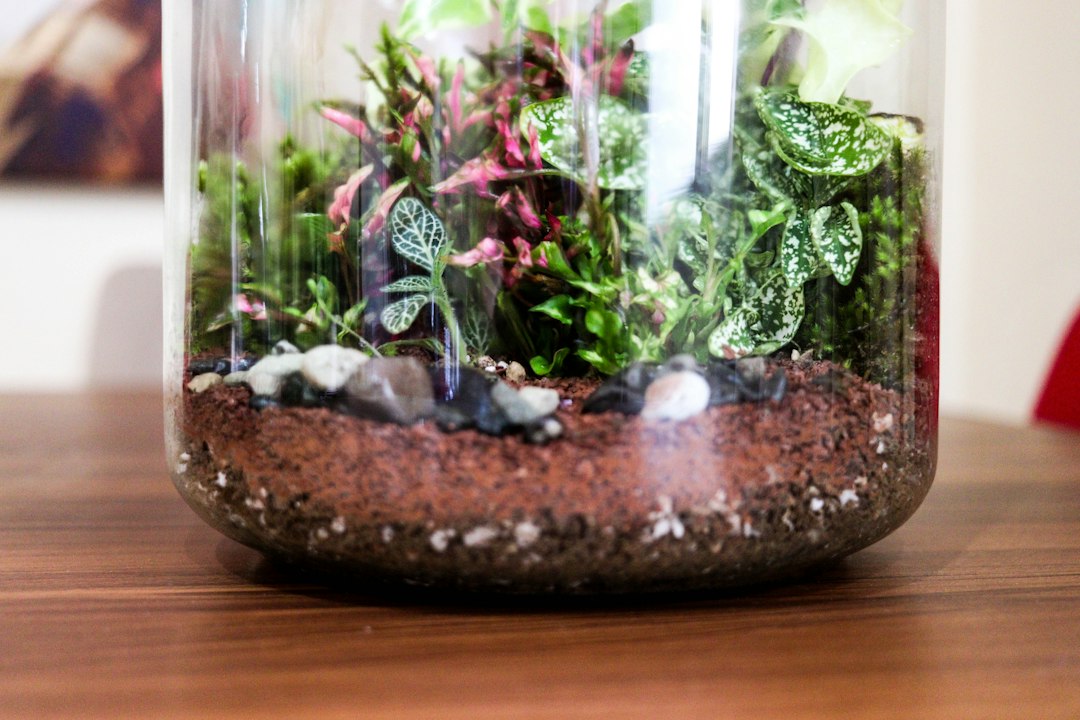
Arrange the scene for its main viewing direction. For a globe viewed primarily from the front, try the tallest element toward the back. If it will be seen from several sides, test the composition by rotating the supported vessel before finishing.
Leave enough room to reach the soil later. An arrangement that blocks the opening may look lush immediately but makes every watering and pruning task harder.
4. Add a restrained finishing layer
Choose one focal accent, such as a small stone beside the main plant. Use the remaining visible surface to guide the eye rather than cover everything. A patch of bare medium can be part of the design.
Keep decorative objects clear of the opening and avoid wedging them against fragile glass. For an air-plant display, omit the soil-building steps and arrange the plant on a removable, dry support instead. Good airflow and drying between waterings remain priorities. (gardeningsolutions.ifas.ufl.edu)
5. Water cautiously and clean the glass
For a planted terrarium, add water in small amounts and check the medium rather than pouring generously. There is no universal dose: container size, plant requirements, and existing moisture all matter. Heavy watering in a vessel without external drainage can leave standing water and encourage root problems. (extension.missouri.edu)
Brush stray medium from leaves and wipe accessible glass. Set the finished display down, step back, and check that you can still see the plants clearly. Make any final adjustments before attaching it to its support.

Turn the display into intentional home decor
Treat the vessel, hanger, and planting as one composition. Choose a simple visual direction before adding accessories: soft woodland greens, a spare sculptural air plant, or a compact foliage garden with one contrasting leaf pattern. Limiting the palette gives each detail a purpose.
Repeat one element, vary another
For a coordinated group, repeat the container shape while varying the planting, or repeat the foliage palette across different vessels. Avoid changing every feature at once. When shape, color, hanger material, and internal decoration all compete, the individual gardens become harder to appreciate.
Try one of these approaches:
- Quiet and minimal: Use one plant, a clear vessel, and a discreet hanger. Let leaf shape provide the detail.
- Woodland-inspired: Combine compatible green foliage with one clean stone and an asymmetrical layout.
- Graphic and contemporary: Pair a geometric vessel with a restrained planting and a simple background.
- A coordinated cluster: Repeat one visual feature across separate containers, leaving clear space between them.
These are starting points, not shopping lists. Use the materials you already like, then remove anything that distracts from the plant.
Balance hanging plants with the room
Consider what sits behind the terrarium. A plain wall can make fine leaves easier to see, while a crowded bookshelf may compete with the miniature scene. Test the view from your usual seat rather than judging only from close range.
If you already have larger hanging plants, give the terrarium its own visual breathing room. Try placing it where the glass outline remains visible instead of hiding it among trailing stems. Coordinate the hangers if you want a unified display, but do not sacrifice plant conditions for symmetry.
Keep seasonal changes simple. Altering a nearby decorative object or the surrounding color palette can refresh the display without disturbing roots or adding clutter inside the vessel.
Keep care practical and observation-based
Build a habit of inspecting the terrarium rather than watering automatically on a fixed day. Open and closed systems behave differently, and conditions can change as plants grow. Check the medium, foliage, and glass together before deciding what to do. (yardandgarden.extension.iastate.edu)
Read moisture signals in context
In a closed terrarium, some condensation is part of the water cycle. If excessive condensation builds up, remove the cover temporarily to let moisture evaporate before replacing it. Do not add more water merely because the calendar says it is watering day. (yardandgarden.extension.iastate.edu)
For an open rooted arrangement, check the growing medium according to the plants’ requirements. For an air plant, remove it for its appropriate watering routine and let it dry before putting it back. Penn State recommends allowing at least four hours of drying after watering before returning an air plant to a terrarium. (extension.psu.edu)
Keep a brief note after watering: what you observed, what you added, and how the display responded. This is more useful than copying a schedule intended for another household.
Prune before access becomes difficult
Remove dead material and trim growth when it begins to crowd neighboring plants or block maintenance. Plants may eventually outgrow even a well-planned terrarium. Replacing an oversized specimen is a normal way to renew the arrangement, not evidence that the project failed. (yardandgarden.extension.iastate.edu)
Make changes while the container rests safely on the table. Clean the glass during the same session, inspect attachment points, and check the hanger for wear. Grouping these tasks makes care easier to remember.
Use a simple inspection routine:
- Look for damaged leaves, debris, or crowding.
- Check moisture before reaching for water.
- Confirm that the opening remains accessible.
- Examine the vessel, hanger, and support.
- Return it only when the outside is clean and dry.
Troubleshoot before adding more water
When the display changes, describe what you see before choosing a remedy. “The soil is wet and the leaves are yellowing” is more useful than “the plant looks unhappy.” Photographs taken from the same angle can also help you notice whether a change is progressing.
Persistent wetness or standing water: Stop watering and assess the moisture level and plant compatibility. Heavy watering in a terrarium without external drainage can encourage root disease. Do not assume a pebble layer makes the excess harmless. (extension.missouri.edu)
Glass that stays heavily fogged: In a closed setup, temporarily uncover the vessel to release excess moisture. Check again before closing it and continue observing rather than making several changes at once. (yardandgarden.extension.iastate.edu)
Growth that overwhelms the scene: Prune suitable plants or replace them with smaller selections. Preserve access and visible space instead of trying to keep every original plant indefinitely. (yardandgarden.extension.iastate.edu)
A design that feels cluttered: Remove an accessory before removing a healthy plant. Try viewing the arrangement against a quieter background or lowering the number of nearby objects. Sometimes the problem is the surrounding composition, not the miniature garden.
Start small and leave room to grow
For your first hanging terrarium, choose one accessible vessel and a restrained planting. Plan the location and support before assembly, then make watering and maintenance easy enough to repeat.
The most satisfying result does not need elaborate layers or a crowded collection of plants. Let a few well-chosen elements carry the design, observe how the garden responds, and adjust thoughtfully. You will have a piece of home decor that invites a closer look—and a manageable gardening project you can continue to enjoy.

De Talis Us


Dejar un comentario
Este sitio está protegido por hCaptcha y se aplican la Política de privacidad de hCaptcha y los Términos del servicio.