


Best Bird Cage Accessories for Parrots Online: A Complete Guide
Parrots are among the most cognitively complex animals kept as pets. In the wild, they spend 6–8 hours a day foraging, climbing, flying, socializing, and solving problems. In captivity, the cage and everything inside it becomes their entire world — which makes what you put in that cage critically important to your bird's physical health, mental wellbeing, and behavior.
An under-furnished cage doesn't just leave a parrot bored. It leads to feather-destructive behavior, screaming, aggression, and chronic stress-related illness — all documented consequences of inadequate enrichment in captive psittacines. By contrast, a thoughtfully accessorized cage with varied perches, foraging opportunities, appropriate lighting, and species-matched toys can dramatically improve a parrot's quality of life.
This guide covers every essential accessory category, explains why each one matters, and points you to the best options available at Talis-us for parrots of all sizes — from conures and cockatiels to African Greys, Amazons, and macaws.
Table of Contents
-
The 6 Essential Accessory Categories Every Parrot Cage Needs
-
1. Perches: The Most Important — and Most Overlooked — Accessory
-
2. Foraging & Enrichment Toys: The Mental Stimulation Imperative
The 6 Essential Accessory Categories Every Parrot Cage Needs

Before diving into specific products, here's a quick reference for what every parrot cage needs at minimum:
| Category | Why It Matters | Minimum Quantity |
|---|---|---|
| Perches | Foot health, posture, mental stimulation | 3–5 (varied types and diameters) |
| Foraging / Enrichment Toys | Prevents boredom, feather-destructive behavior | 3–6 (rotated regularly) |
| Food & Water Dishes | Hygiene, proper nutrition delivery | 2–3 dedicated stations |
| Full-Spectrum UV Lighting | Vitamin D3 synthesis, circadian rhythm, feather pigment | 1 species-appropriate UV lamp |
| Treats & Foraging Foods | Nutrition + behavioral enrichment | Daily rotation |
| Play Stand / Out-of-Cage Space | Exercise, social interaction, mental health | 1 (minimum) |
1. Perches: The Most Important — and Most Overlooked — Accessory
A parrot stands on its feet 24 hours a day, every day of its life. Perch quality, variety, and diameter directly determine whether that bird develops healthy feet, exercises its musculature properly, and avoids conditions like pododermatitis (bumblefoot), arthritis, and pressure sores.
Patty Jourgensen, avian specialist and founder of BirdTricks, who has worked with rescue birds since 1987, documents this directly from experience with her own Goffin's cockatoo — a pressure sore discovered from insufficient perch diameter variation that resolved immediately after adjusting the perch to the proper diameter. Her conclusion: "Varying diameters in the perches will help your birds avert such problems as arthritis and atrophy and strengthen and increase dexterity in the feet." (BirdTricks, 2023)
The 5 Perch Types Every Cage Should Have
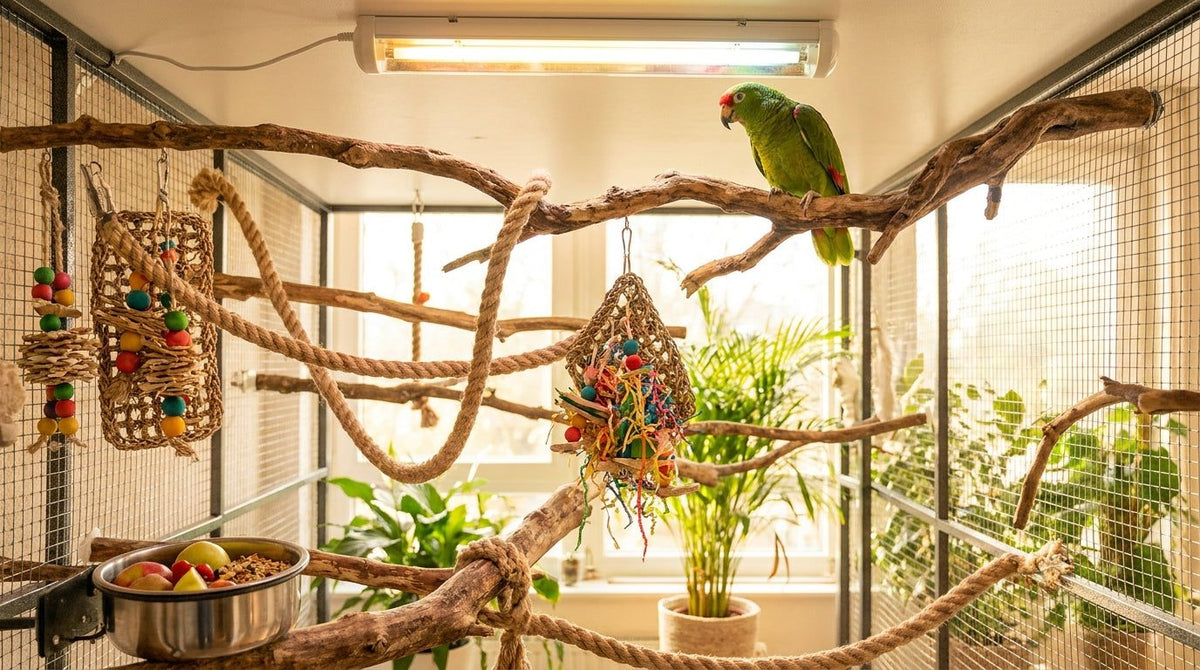
1. Natural Wood (Manzanita / Dragonwood) — The Primary Perch Natural wood branches with irregular diameters, textures, and angles most closely mimic wild foraging branches. The variation in grip width exercises different foot muscles with every step. Manzanita is the most widely recommended for its durability, non-toxicity, and irregular shape. Dragonwood is an excellent alternative with similar properties and an interesting twisted form parrots enjoy investigating.
What to look for: Irregular, varying diameter along the length; non-toxic wood species; appropriate overall diameter for your bird's foot size (toes should wrap approximately ¾ around the perch). (Red Bluff Animal Hospital, 2025)
2. Rope / Natural Fiber Perch — The Comfort Perch Soft rope perches (cotton, sisal, or natural fiber) provide relief from harder wooden surfaces — particularly valuable for senior birds with arthritis, birds recovering from foot injuries, or any bird spending long hours on the primary perch. Their flexibility also provides proprioceptive challenge, engaging stabilizer muscles.
Caution: Rope perches must be monitored closely for fraying. Loose threads can entangle toes and nails, and ingestion of rope strands can cause crop impaction. Trim any fraying immediately and replace when heavily worn. (BirdTricks, 2023)
3. Sandy / Textured Perch — The Nail-Maintenance Perch Sandy or slightly abrasive textured perches help keep nails trimmed naturally and stimulate circulation in the feet. They are not appropriate as primary all-day perches — the abrasive texture will irritate skin with prolonged contact — but positioned near food bowls or in areas of brief frequent use, they serve a practical maintenance function.
Note: BirdTricks now advises against cement perches specifically due to reports of lead content in some products. Sandy perches with plastic or wood bases are the recommended alternative.
4. Platform / Shelf Perch — The Rest & Play Surface A corner or flat platform perch gives a parrot's feet a chance to fully flatten and stretch — a position impossible on any round perch. This is particularly important for foot health in older birds and provides a stable surface for toy manipulation, eating, and relaxed observation. Many parrots choose platform perches for sleeping.
5. Swing Perch — The Dynamic Perch A hanging swing perch moves with the bird, engaging balance, core muscles, and confidence. Swings also provide a playful element that many parrots actively seek out — the movement mimics wind-loaded branches in the wild and provides a form of stimulation that static perches don't.
Perch Diameter Guide by Species
| Species | Recommended Diameter |
|---|---|
| Budgerigar, Parrotlet | ½" – ¾" |
| Lovebird, Conure | ¾" – 1" |
| Cockatiel, Caique | ¾" – 1.25" |
| African Grey, Amazon | 1" – 1.5" |
| Cockatoo (medium) | 1.25" – 1.75" |
| Macaw | 1.5" – 2.5"+ |
2. Foraging & Enrichment Toys: The Mental Stimulation Imperative

Parrots are among the most intelligent animals studied — comparable in cognitive ability to great apes and young human children across multiple studies. In the wild, this intelligence is fully engaged by the demands of foraging, navigating complex social hierarchies, and problem-solving for survival.
In captivity, that same intelligence with nothing meaningful to do becomes destructive. The Association of Avian Veterinarians (AAV) and avian welfare organizations consistently identify inadequate enrichment as the primary driver of the most common behavioral problems in pet parrots: feather-destructive behavior, repetitive stereotypies, excessive vocalization, and aggression.
The AAV specifically notes: "Parrot enrichment includes enclosure toys, puzzles, and perches that the bird can actively engage with, and foraging stations that pique your bird's natural feeding instincts." (AAV, Dec 2025)
Toy Categories Every Parrot Cage Needs
Shreddable / Destructible Toys Parrots are wired to chew, tear, and shred. Providing destructible toys — palm leaf, paper, balsa wood, cork, woven seagrass — satisfies this drive constructively. A parrot that tears apart a toy is engaging in a natural, healthy behavior. A parrot with nothing to destroy will redirect to cage bars, moldings, furniture, and its own feathers.
Rule of thumb: If your parrot's toys never look destroyed or worn, they aren't engaging with them meaningfully. The goal is providing things that should be destroyed.
Foraging Toys Foraging is the behavior that defines wild parrot life — locating, extracting, and consuming food takes up a significant portion of their waking hours. Foraging toys replicate this by hiding treats inside woven materials, behind sliding doors, under removable covers, or within layered compartments. The bird must investigate, manipulate, and problem-solve to access its reward.
Even simple foraging setups — wrapping a treat in paper, threading millet through a toy, tucking food in a foraging box — provide far more psychological benefit than presenting food in an open bowl.
Puzzle Toys Level-appropriate puzzle toys engage problem-solving ability. Start with simpler formats and increase complexity as the bird masters each stage. Many parrots — particularly African Greys, cockatoos, and Amazons — benefit from puzzle complexity that would challenge a young child.
Hanging Toys (Bells, Beads, Mirrors, Tassels) Hanging toys provide tactile and auditory stimulation, satisfy batting and manipulation drives, and give parrots objects to interact with throughout the day. Variety matters — different materials (wood, acrylic, metal), colors, textures, and sounds engage different sensory systems.
Toy Rotation Rule Introducing too many toys simultaneously can overwhelm a bird. Conversely, leaving the same toys in place indefinitely leads to habituation — the bird stops engaging with them. The recommended approach:
-
Keep 3–6 toys in the cage at any time
-
Rotate 1–2 toys out every 5–7 days, replacing with "rested" toys
-
A toy that's been away for two weeks registers as new when reintroduced
3. Food & Water Stations: More Than a Bowl
The dish setup inside a parrot's cage has more impact on nutrition and health than most owners realize.
Stainless Steel — The Only Recommended Material Plastic dishes crack, develop microscopic surface scratches that harbor bacteria, and can leach chemicals when exposed to acidic foods (fruits, citrus). Ceramic dishes are safer but can chip and crack. Stainless steel dishes are non-porous, dishwasher-safe, and durable. They are the standard recommendation from avian veterinarians and are worth the small premium. (Red Bluff Animal Hospital, 2025)
Placement Dishes should be positioned mid-height to upper-height in the cage, not at the bottom. Parrots instinctively distrust ground-level feeding and will often avoid bowls placed too low. Position food dishes away from perches directly above to prevent fecal contamination.
Daily Cleaning All food and water dishes should be removed, washed, and replaced daily. Moist foods especially (fresh fruit, vegetables, cooked foods) harbor bacteria rapidly in the warm interior of an enclosure.
Millet Lunch Bowls & Foraging Dishes Beyond standard bowls, dedicated foraging feeders — dishes designed to present food in a way that encourages exploration and manipulation — add enrichment value to every meal. Specialty feeder formats like the Vitapol Millet Lunch Bowl and Coconut Lunch Bowl provide both nutrition and behavioral engagement in a single item.
4. Full-Spectrum UV Lighting: The Invisible Requirement
Full-spectrum UV lighting is one of the most science-supported — and least implemented — cage accessories for captive parrots.
Wild parrots receive natural sunlight year-round, which delivers both UVA and UVB wavelengths essential for multiple physiological processes. In captivity, window glass filters out virtually all UVB radiation — the wavelength required for vitamin D3 synthesis in the skin. Without UVB, parrots cannot produce adequate vitamin D3 regardless of dietary supplementation.
Why this matters:
-
UVB → Vitamin D3 → calcium absorption → bone density, egg production, neurological function
-
UVA → parrots see into the UV spectrum; without UVA lighting, the plumage of fellow birds (and the visual richness of their environment) looks grey and muted to them — a significant welfare impact
-
Circadian rhythm → full-spectrum light signals the natural light cycle, supporting hormonal balance, mood, and sleep quality
The Arcadia PureSun range, developed specifically for captive birds, provides a precisely calibrated UVB percentage appropriate for parrots' UV requirements without the intensity overexposure risks associated with reptile-grade lighting.
Positioning: Mount the UV lamp outside the top of the cage (not inside), positioned so the bird can perch within the effective UV range (typically 6–18" from the lamp, check the specific product's UVI output specifications). Allow birds to self-regulate exposure by ensuring UV-free zones exist lower in the cage.
Replacement schedule: UV output degrades before visible light output fails. Replace lamps every 6–12 months regardless of whether they still appear to glow — the UVB output drops significantly well before visible failure.
5. Nutrition: Treats, Supplements & Foraging Foods
The nutritional accessories in a parrot's cage are as important as the physical ones.
The Balanced Parrot Diet Framework
High-quality pellets (60–70% of diet) Pellets are nutritionally formulated to provide complete and balanced nutrition — the single most important upgrade from a seed-only diet. A parrot on seeds alone is essentially eating the equivalent of junk food: high in fat, deficient in over 30 essential nutrients, and leading to early-onset conditions including fatty liver disease, nutritional deficiencies, and shortened lifespan.
For large parrots (Amazons, African Greys, cockatoos, macaws): choose a large-parrot formulated pellet — the A&E Cage Company Vita Line Large Parrot Food is a well-regarded option meeting AAFCO nutritional standards.
For smaller species (cockatiels, budgies, small conures): species-specific formulations matter — the A&E Vita Lone Complete Food for Cockatiels and Vita Lone Complete Food for Budgies are formulated to the specific nutritional ratios of these species.
Fresh produce (20–30% of diet) Bird-safe vegetables and fruits should form a regular part of the diet: dark leafy greens (kale, swiss chard, spinach), bell peppers, squash, carrots, cooked sweet potato, and limited fruits. Fresh food also provides critical foraging enrichment value — a bird working to extract nutritious food from a fresh piece of broccoli is behaving naturally.
Seeds and treats (10% or less) Seeds are high-palatability treats — appropriate for training rewards, foraging enrichment, and dietary variety, but not as a dietary staple. Spray millet is a particularly well-loved natural treat for most parrot species, suitable for foraging activities and positive reinforcement training.
Cuttlebone / Mineral supplements Cuttlebone provides calcium, phosphorus, and trace minerals while simultaneously satisfying beak-conditioning and chewing behavior. It should be present in every parrot cage as a permanent free-choice supplement. The beak conditioning benefit also helps maintain proper beak shape and prevents overgrowth.
The A&E Vitapol Vita Line Smakers Paradise treats are formulated foraging sticks for large parrots — combining nutritional value with a format that encourages gnawing, investigating, and foraging behavior.
6. Play Stands & Out-of-Cage Spaces
Even the most enriched cage is a limited environment. Parrots need supervised out-of-cage time daily — the recommended minimum is 2–3 hours of interaction and environmental exploration outside the enclosure.
A parrot play stand with ladders, perches, toy hooks, and food cups provides a structured out-of-cage station where a bird can spend time safely near its owner, engage with different toys, and exercise without the constraints of the cage interior.
The A&E Cage Company Parrot Play Stand with Ladders and Toy Hooks is a full-featured out-of-cage station suitable for medium to large parrots — it provides climbing ladders for exercise, toy attachment hooks for enrichment, and a stable play surface for interaction and training.
A play stand serves a secondary function: it normalizes moving between different environments, which reduces the territorial cage-defense behavior some parrots develop when they spend too much time confined to a single space.
Cage Placement & Accessory Layout Tips
How you arrange accessories inside the cage matters almost as much as which accessories you choose.
Height hierarchy: Parrots are prey animals — height equals safety. The highest perch in the cage will be where your bird spends the most time and sleeps. Position the primary perch at or near the top of the cage, at least one perch diameter away from the cage walls and bars to prevent wing and tail feather damage.
Sleeping perch placement: Position the sleeping perch near a corner of the cage — the enclosed feel provides psychological security. (Windy City Parrot, 2023)
Food dish placement: Mid to upper cage height, not beneath perches directly above them. Position dishes away from foraging toys to maintain clear activity zones.
Toy placement: Hang enrichment toys at beak height on the primary perch or slightly above — birds should be able to investigate and manipulate toys from a comfortable standing position. Avoid cluttering the cage so densely that flight paths are blocked.
UV lamp: Mount above or outside the upper section of the cage. Never inside where the bird could contact the lamp surface directly.
Bottom of cage: Keep clear. The cage floor should be lined with clean paper or cage liner for easy hygiene maintenance. Parrots should not be encouraged to spend time on the cage floor.
Accessories to Avoid — Safety Checklist
Not everything marketed for birds is safe. These items are best avoided:
| Avoid | Why |
|---|---|
| Sandpaper perch covers | Cause abrasion sores, cracked skin, pododermatitis |
| Cement perches | Some test positive for lead; if swallowed, can cause toxicity and crop impaction |
| Plastic dishes | Harbor bacteria in micro-scratches; potential chemical leaching |
| Galvanized metal hardware | Zinc toxicity risk if chewed — use stainless steel only |
| Mirrors for solitary parrots | Can cause chronic psychological confusion and hormonal stimulation in birds without a companion |
| Heavily frayed rope perches | Toe entanglement and ingestion risk |
| Artificial fabric toys with loose threads | Crop impaction risk if ingested |
| Treated/painted woods | Lead, zinc, and chemical toxicity — use only confirmed bird-safe wood products |
| Aromatic candles, Teflon cookware, air fresheners near birds | Avian respiratory systems are extremely sensitive to volatile organic compounds and PTFE fumes |
Parrot Size Guide: Matching Accessories to Species
| Size Category | Common Species | Key Accessory Notes |
|---|---|---|
| Small parrots | Budgerigar, Parrotlet, Lovebird | Smaller perch diameters (½–¾"); lightweight hanging toys; small foraging dishes |
| Small-medium | Conure, Caique, Senegal | ¾–1" perch diameter; moderate-duty chew toys; millet and spray treats |
| Medium | Cockatiel, Quaker, Pionus | 1–1.25" perch; rope swings; puzzle toys of moderate complexity |
| Medium-large | African Grey, Amazon, Eclectus | 1–1.5" perch; durable hard-wood chew toys; foraging complexity level 2–3 |
| Large | Cockatoo, Large Macaw | 1.5–2.5"+ perch; heavy-duty stainless construction; highest foraging complexity |
Our Parrot Picks at Talis-us
Talis-us carries a curated selection of bird accessories meeting our Talis Curated standard for quality, safety, and species-appropriateness. Every product in our bird collection is selected for real enrichment value — not just novelty.
🏠 Cages & Enclosures
PENN-PLAX Conure & Small Parrot Starter Kit with Birdcage A complete starter setup for conures and small parrots — includes the cage plus essential accessories to get started immediately. Horizontal bar construction for climbing, secure latches, and a removable bottom tray for hygiene. An excellent foundation for a first parrot setup.
- $169.99
Prevue Pet Products Imperial Extra Large Stainless Bird Cage An investment-grade stainless steel cage for large parrots — African Greys, Amazons, cockatoos, or macaws. Stainless steel eliminates powder-coat wear concerns, resists bacteria, and is easy to sanitize. Extra-large footprint provides genuine space for flight and movement. Built to last a bird's lifetime.
- $1,899.99
🌿 Nutrition & Food
A&E Cage Company Vita Line Parrot Food for Large Parrots — 4.41 lb A nutritionally complete seed and pellet blend specifically formulated for large parrot species. Provides the variety of seeds, grains, and pellets that large parrots need, with species-appropriate protein and fat ratios.
- $29.99
A&E Cage Company Vita Lone Complete Food for Cockatiels — 4.85 lb Species-formulated complete nutrition for cockatiels — the most commonly kept parrot species in the US. Balanced for cockatiel-specific dietary requirements, including appropriate vitamin A, D3, and calcium levels.
- $29.99
A&E Cage Company Vita Lone Complete Food for Budgies — 4.85 lb Complete nutrition specifically formulated for budgerigars (parakeets). Budgies have distinct nutritional needs from larger parrots — this formula is calibrated to their requirements rather than being a scaled-down large-bird formula.
- $29.99
🎯 Enrichment & Treats
A&E Cages Happy Beaks Spray Millet Bird Treat Natural spray millet — one of the most universally loved treats across virtually every parrot species. Excellent for hand-taming, positive reinforcement training, foraging enrichment, and as a high-palatability dietary supplement. Natural, unprocessed, and species-appropriate.
- $6.99 (small) / $12.99 (large)
A&E Cages Vitapol Vita Line Smakers Paradise for Large Parrots — 280g, 2-pack Foraging-format treat sticks for large parrots — nutritionally enriched with seeds, fruits, and vitamins pressed into a stick format that encourages natural gnawing and foraging behavior. Hang inside the cage or on a play stand. Each pack contains two sticks for variety.
- $13.99
A&E Cages Vitapol Vitaline Millet Lunch Bowl A ready-to-hang millet foraging bowl — provides natural spray millet in a convenient clip-on dish that attaches directly to cage bars. Works for all bird sizes. Encourages natural foraging behavior during mealtime.
- $15.99
A&E Cages Vitapol Vitaline Coconut Lunch Bowl A coconut-formulated foraging bowl — coconut provides healthy natural fats and a palatable variety from standard millet, supporting dietary variety while maintaining the natural foraging format.
- $15.99
💡 Lighting
Arcadia PureSun Bird Mini Bulb 8W — Full-Spectrum UV-B Lamp for Birds Arcadia's bird-specific UV bulb, engineered to deliver the correct UVA and UVB spectrum for captive parrots without overexposure risk. Compact 8W mini format fits standard lamp holders. Provides Vitamin D3 synthesis support, improves circadian regulation, and allows parrots to see the full UV spectrum their visual system is designed for. One of the most evidence-backed welfare improvements you can make for any captive bird.
- $28.99
PureSun MIDI 22" Bird 2.4% UV Bulb Replacement Lamp — 14W The larger-format replacement tube for the Arcadia PureSun MIDI system — 22" length provides wider UV coverage for larger cages or aviaries housing medium to large parrots. 2.4% UVB output is calibrated for avian requirements. Replace every 6–12 months regardless of visible light output.
- $35.99
🪵 Out-of-Cage Play
A&E Cage Parrot Play Stand with Ladders and Toy Hooks A freestanding parrot gym with climbing ladders, multiple perch levels, and toy attachment hooks. Designed for medium to large parrots. Provides a dedicated out-of-cage activity station where your bird can exercise, play, and socialize with you safely — an essential complement to any parrot cage setup.
- $299.99
👉 Shop the full parrot and bird collection at Talis-us →
FAQs
What accessories does every parrot cage need? At minimum: 3–5 varied perches (natural wood, rope, platform), 3–6 foraging and enrichment toys, stainless steel food and water dishes, full-spectrum UV lighting, appropriate species-formulated food, and treats for enrichment. A play stand for out-of-cage time rounds out a complete setup.
How many perches should be in a parrot cage? Three to five perches of different materials, diameters, and textures. Variety is more important than quantity — a single natural manzanita perch of appropriate diameter is more beneficial than five identical wooden dowels. Including at least one rope perch, one natural wood perch, and one platform perch covers the key categories.
Do parrots need UV lighting indoors? Yes — this is consistently supported by avian veterinary guidance. Window glass filters virtually all UVB radiation. Without a full-spectrum UV lamp, captive parrots cannot synthesize adequate Vitamin D3, which affects calcium metabolism, immune function, and overall health. A bird-specific UV lamp like the Arcadia PureSun is the recommended solution.
How often should I rotate parrot toys? Rotate 1–2 toys out every 5–7 days. A toy that's been resting for 2 weeks will register as new when reintroduced, maintaining engagement without requiring constant new purchases. Avoid introducing too many new toys simultaneously, which can trigger neophobia (fear of novelty) in some birds.
Are seed-based diets adequate for parrots? No — a seed-only diet is nutritionally incomplete and is consistently associated with shortened lifespan, fatty liver disease, and vitamin and mineral deficiencies. High-quality pellets should form 60–70% of a parrot's diet, supplemented with fresh produce and seeds as treats. (Red Bluff Animal Hospital, 2025)
What toys are best for large parrots like African Greys and Amazons? Large parrots need heavy-duty, mentally stimulating toys — hardwood chew toys, foraging boxes with multiple compartments, puzzle toys of level 2–3 complexity, and destructible items like natural palm leaf and cork. African Greys in particular are among the most cognitively demanding parrots to keep enriched — foraging and puzzle complexity should be progressively increased as they master each challenge.
How do I introduce new accessories to a nervous parrot? Introduce new items gradually — place a new toy outside the cage for a few days so the bird can observe it before it enters the enclosure. Once inside, position it at a distance from the bird's primary perch initially and allow the bird to approach on its own terms. Never force interaction with a new accessory.
Is a play stand necessary if the bird has a large cage? Yes — even in a large cage, a play stand serves a distinct welfare function. Out-of-cage time in a different environment reduces territorial cage-defense behavior, provides different physical challenges, and allows for the kind of direct social interaction with humans that most parrots need for psychological health. Think of the cage as sleeping/eating space and the play stand as the living room.
This guide is for informational purposes. Always consult a certified avian veterinarian for individualized health and husbandry recommendations for your specific parrot species.

De Talis Us


Dejar un comentario
Este sitio está protegido por hCaptcha y se aplican la Política de privacidad de hCaptcha y los Términos del servicio.